
Recycling end-of-life tyres: pyrolysis compared with cement kilns, granulate and export

28.10.2026
Recycling end-of-life tyres: pyrolysis compared with cement kilns, granulate and export
In short: Germany generates around half a million tonnes of end-of-life tyres every year. A large share is processed into granulate or burned in cement kilns, and some is exported. Pyrolysis breaks the tyre down into oil, carbon black, steel and gas and thus preserves more material than incineration. In life cycle assessments it usually performs better than co-incineration in cement kilns; how much better depends on the assumptions. The prerequisite is a permitted, properly operated plant.
End-of-life tyres do not have a good reputation, and neither does tyre pyrolysis in every case. Images of burning tyre dumps or smoking backyard plants shape perceptions. At the same time, a tyre is a high-quality mix of materials made of rubber, carbon black, steel and textile. This article puts the recovery routes into context: what happens to end-of-life tyres today, what life cycle assessments show and under what conditions pyrolysis makes sense.
Sebastian Kießling
Managing Director Technology, pyropower GmbH

Key facts at a glance
- Around 533,000 tonnes of end-of-life tyres were generated in Germany in 2024 (German Rubber Industry Association, wdk).
- Just over a third is processed into granulate and rubber powder, around 17 percent goes to cement kilns and almost a quarter is exported. For around 100,000 tonnes the whereabouts are unknown.
- Pyrolysis yields oil, recovered carbon black (rCB), steel and gas. It thus preserves more material than incineration.
- In a life cycle assessment by Fraunhofer UMSICHT (2023), the net saving of pyrolysis was 703 kg CO₂e per tonne of end-of-life tyres, compared with 309 kg for cement kilns under German conditions. Other studies see a smaller gap.
- Operation is decisive: uncontrolled pyrolysis releases pollutants. Permitted plants with gas cleaning and flue gas treatment are the prerequisite.
End-of-life tyres in figures
According to the German Rubber Industry Association (wdk), around 533,000 tonnes of end-of-life tyres were generated in Germany in 2024. Across Europe, the last complete statistics from Tyres Europe for 2021 show around 3.5 million tonnes in 32 countries. The figures differ depending on the source and definition, which is why we always state the source and year.
| Recovery route in Germany | Volume 2024 | Share |
|---|---|---|
| Granulate and rubber powder | 193,000 t | around 36 % |
| Export to various recovery routes | 120,000 t | around 23 % |
| Cement kilns | 93,000 t | around 17 % |
| Retreading | 20,000 t | around 4 % |
| Reuse in Germany | 8,000 t | around 1.5 % |
| Whereabouts unknown | around 100,000 t | around 19 % |
Source: wdk, cited in an expert report by the Research Services of the German Bundestag (2026). Shares rounded, own calculation.
A car tyre consists roughly of three quarters rubber compound, around 15 percent steel and around 10 percent textile. The rubber compound contains natural and synthetic rubber, carbon black, silica, oils, sulphur and zinc oxide. According to C14 measurements, around 18 percent of the carbon in car tyres comes from biogenic sources, mainly natural rubber, and around 29 percent in truck tyres.
Five routes for an end-of-life tyre
Landfill: banned in the EU
The Landfill Directive 1999/31/EC prohibits the landfilling of whole end-of-life tyres and, with a somewhat longer transition period, of shredded tyres as well. Exceptions apply, for example, to bicycle tyres and very large tyres.
Retreading and reuse
The highest-value form of recovery: the casing is kept and only the tread is renewed. This works mainly for truck tyres, but concerns only a small share of the volume.
Granulate and rubber powder
The tyres are shredded and steel and textile are separated. The granulate is used in floor coverings, mats, asphalt or as infill on artificial turf. Life cycle assessments rate this route favourably as long as the granulate replaces a new material. However, an important market is disappearing: from 17 October 2031, the EU bans placing infill granulate for artificial turf on the market (Regulation (EU) 2023/2055) because it releases microplastics into the environment. Since 2022, granulate on artificial turf and playgrounds has also been subject to a limit of 20 mg/kg for the sum of eight polycyclic aromatic hydrocarbons (PAHs).
Cement kiln
End-of-life tyres have a calorific value of around 26 to 32 MJ/kg and replace other fuels in the cement kiln. The steel is bound into the clinker. This is an orderly but energy-based recovery: rubber and carbon black are burned and the material is lost. Because German cement plants already run to a large extent on secondary fuels, tyres there do not necessarily displace fossil coal but partly other waste-derived fuels.
Export
Almost a quarter of German end-of-life tyres is exported, and for around 100,000 tonnes the whereabouts are unknown. The wdk assumes that some of them are burned under poor conditions in countries outside the EU or pyrolysed in simple plants. Investigations in India have found numerous plants without permits, and in 2026 the UK Environment Agency stopped shipments to many recipients. From May 2027, non-hazardous waste from the EU may only be exported to listed countries outside the OECD.
How risky uncontrolled storage sites are was shown in 2016 by the fire in Seseña, Spain, in which an estimated five million tyres burned. Open tyre fires release PAHs, dioxins and furans, among other substances.
Pyrolysis: oil, carbon black, steel and gas from the tyre
In pyrolysis, the shredded tyre is heated in the absence of oxygen, usually to 450 to 600 °C. The polymer chains of the rubber break down into smaller molecules. Based on the steel-free rubber granulate, the typical yields are:
- around 45 percent pyrolysis oil (range 30 to 60 percent) with a calorific value of around 41 to 44 MJ/kg,
- around 40 percent solid residue, processed into recovered carbon black (rCB),
- 10 to 15 percent pyrolysis gas,
- plus the steel separated beforehand, around 15 percent of the tyre mass.
The oil can serve as a raw material in the chemical industry. Pyrolysis oil from end-of-life tyres is used in steam crackers, for example, with the allocation to new products made on paper via a mass balance according to ISCC PLUS. The recovered carbon black replaces part of the newly produced carbon black in rubber compounds. Studies give substitution rates of 50 to 70 percent, and upgraded rCB achieves even more. Because the production of new carbon black is associated with around 2.4 to 3.4 kg CO₂e per kilogram, this is where pyrolysis has its greatest lever.
The pyrolysis gas consists of hydrogen, methane, short-chain hydrocarbons, carbon monoxide and carbon dioxide. Because tyres are vulcanised with sulphur, it contains hydrogen sulphide, on average around 3.6 percent by volume in measurements. Its calorific value is usually in the order of 30 to 40 MJ per standard cubic metre.
Life cycle assessments compared
Life cycle assessments compare the routes by setting the emissions of a process against the credits for the products it replaces. Three studies are particularly revealing:
- Fraunhofer UMSICHT (Maga et al., 2023): Net saving of 703 kg CO₂e per tonne of end-of-life tyres for pyrolysis, 309 kg for cement kilns under German conditions and 660 kg with a European fuel mix. Granulate as artificial turf infill reached 834 to 1,468 kg, depending on the material replaced. The study was partly funded by a pyrolysis company and is based on its plant data. With a different data set for carbon black, the saving from pyrolysis falls to 366 kg.
- RIVM (Netherlands, 2023): The state institute sees pyrolysis almost level with cement kilns on climate, but clearly ahead on material retention. Mechanical recycling retains the most material.
- FORCE Technology and ifeu (2020, commissioned by a granulate producer): Granulate recycling saves considerably more than cement kilns. Pyrolysis was not examined.
The results show a clear pattern: material recovery routes perform better than co-incineration in cement kilns in all three studies. How large the advantage of pyrolysis turns out to be depends mainly on how much new carbon black the rCB actually replaces. Compared with granulate, pyrolysis has its place where granulate finds no market, for example when the market for artificial turf infill disappears, or for tyre fractions that are difficult to recover mechanically. Compared with uncontrolled export, a permitted plant in Germany is in any case the more traceable route.
The limits of pyrolysis
Pyrolysis in itself is not a mark of quality. Simple plants without gas cleaning and flue gas treatment release benzene, PAHs and dioxins. There have also been economic setbacks: a German pyrolysis company became insolvent in 2020, and other suppliers are not yet covering their costs. And the products need upgrading: raw rCB contains around 15 percent ash, and the oil contains sulphur and aromatic compounds.
This defines the requirements for a good plant: a permit under the Federal Immission Control Act, continuous operation, gas cleaning, combustion with flue gas treatment and customers who use rCB and oil as materials.
Legal framework
Under the waste hierarchy of the German Circular Economy Act (§ 6 KrWG), recycling takes priority over energy recovery. Only what is not processed for energy generation or into fuels counts as recycling. For pyrolysis this means: if rCB is used as a filler or oil as a chemical feedstock, this can count as recycling. If gas or oil is used as fuel, this is energy recovery. Whether pyrolysis as a whole is recognised as recycling is still open at EU level, and there are no uniform end-of-waste criteria for tyre pyrolysis products so far.
In terms of permits, thermal processes such as pyrolysis fall under number 8.1.1 of Annex 1 of the 4th BImSchV. If the pyrolysis products are burned, the requirements of the 17th BImSchV for waste incineration plants generally apply. The ordinance provides an exception for cleaned pyrolysis gas that causes no other or higher emissions than natural gas.
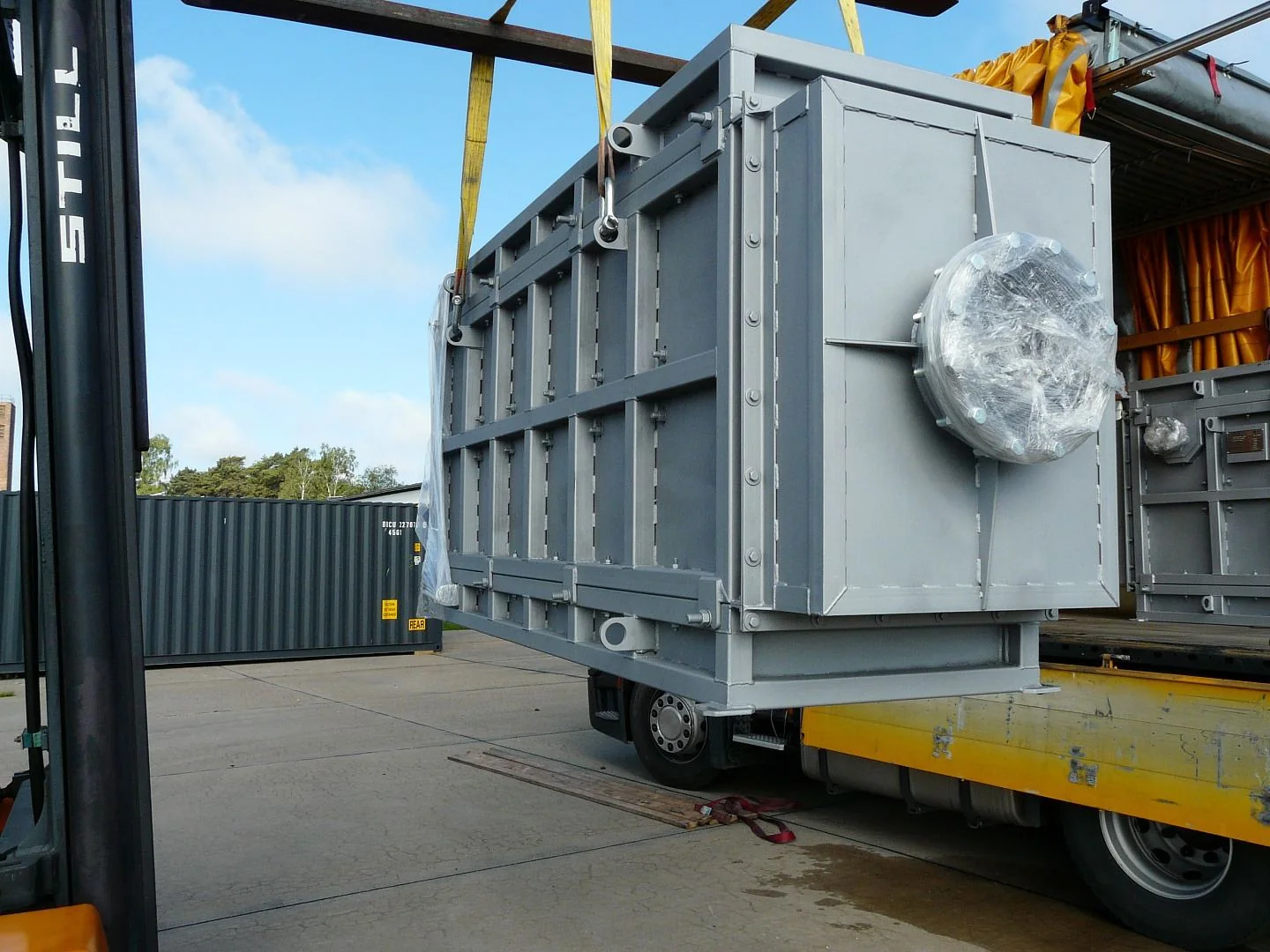
Power from pyrolysis gas with ClinX Heat
In many plants, the pyrolysis gas is used to heat the process itself. If energy is left over, it can be converted into power. This is where ClinX Heat comes in: the gas is burned in a combustion chamber, a high-temperature heat exchanger transfers the heat to clean, compressed air, and only this air drives a micro gas turbine. Sulphur compounds and other components of the gas remain on the flue gas side.
Converting the gas into power is energy recovery. It complements the material use of oil and rCB rather than replacing it. Five ClinX Heat 150 are in operation at an end-of-life tyre pyrolysis plant in Saarland, and five more are being planned for a site in Greece.
Frequently asked questions
Is end-of-life tyre pyrolysis harmful to the environment?
That depends on how the plant is operated. Simple plants without gas cleaning and flue gas treatment are problematic. Permitted plants with flue gas cleaning whose products are used as materials usually perform better in life cycle assessments than co-incineration in cement kilns.
Does end-of-life tyre pyrolysis count as recycling?
Partly. If rCB and oil are used as materials, this can count as recycling. Using gas or oil as fuel counts as energy recovery.
May end-of-life tyres be landfilled?
No. In the EU, landfilling whole and shredded end-of-life tyres is prohibited, with a few exceptions.
Does rCB fully replace new carbon black?
Not fully. Studies give substitution rates of 50 to 70 percent, and more with upgrading. How much is actually replaced largely determines the climate balance of pyrolysis.
Sources
- Research Services of the German Bundestag (2026): Expert report WD 8-3000-0006/0007 on end-of-life tyres, with wdk data for 2024. bundestag.de
- Tyres Europe (2025): End-of-Life Tyres Recovery 2021. tyreseurope.org
- Maga, D. et al. (2023): Resources, Conservation and Recycling 199, 107255. sciencedirect.com
- RIVM (2023): Report 2023-0359. rivm.nl
- FORCE Technology, ifeu (2020): Life cycle assessment of end-of-life tyre recovery, commissioned by Genan.
- Directive 1999/31/EC on the landfill of waste. eur-lex.europa.eu
- Regulation (EU) 2023/2055 on intentionally added microplastics. eur-lex.europa.eu
- German Circular Economy Act, § 6. gesetze-im-internet.de
- Han, W. et al. (2023): Polymers 15, 1604. pmc.ncbi.nlm.nih.gov
- Czajczyńska, D. et al. (2022): International Journal of Hydrogen Energy, doi:10.1016/j.ijhydene.2022.03.082.
- German Environment Agency (UBA): Factsheet on the cement industry. umweltbundesamt.de
- Environment Agency (2026): Regulation of waste pneumatic tyres and their export, progress update March 2026. gov.uk


 info@pyro-power.com
 +49 355 866 870 82
 pyropower GmbH