
Biomass district heating: what it costs and earns for a municipality
12.11.2026
Biomass district heating: what it costs and earns for a municipality
In short: Biomass district heating can be a good solution for municipalities: a pyrolysis plant supplies the base load for the heating network, plus electricity and biochar. In our highly simplified example, a Pyro-ClinX 150 with a boiler house costs around €3.5m and earns a surplus of around €427,000 a year. Below, we explain what municipalities should know.

Lucie Töpfer
Managing Director, pyropower GmbH

The example at a glance
| Operator | Municipality with a district heating network |
| Plant | Pyro-ClinX 150 in a new boiler house |
| Regional wood chips per year | 3,780 t |
| Project price, net, incl. boiler house | €3.5m |
| Revenue per year | €1.1m |
| Costs per year | €0.65m |
| Surplus per year | €427,000 |
| Payback | 8.1 years |
| CO₂ stored per year (calculated) | 1,720 t |
Important: This is a highly simplified example based on assumptions from our profitability calculator. It is not generally valid. Every site is different, so we always calculate each project individually with your figures. We are happy to provide a detailed calculation and the exact project price for your site on request.
How the plant works
In the example, the plant is located in a new boiler house and supplies the municipality’s district heating network:
Example: one year of Pyro-ClinX 150 in a district heating network
Input ›››
3,780 t
wood chips from the region per year
Plant ›››
Pyro-ClinX 150
around 8,000 hours a year
Output per year
Electricity
1,040 MWh, fed in under the EEG
€130,000
Heat
1,500 MWh in the heating network
€90,000
Biochar
600 t
€600,000
CO₂ certificates
1,720 t CO₂
€258,000
Revenue: around €1.1m per year. Surplus after all costs: around €427,000 per year.
In the example, the municipality feeds the electricity into the grid under the EEG. It can just as well use it itself and replace grid electricity.
Returns and payback
Example: revenue and costs per year
Example: surplus after deducting the project price
0
5
10
15
Years of operation
Project price not yet recovered Profit
In the example, the project price is recovered after around 8.1 years, without funding. If the municipality uses the electricity itself, it would be around 7.2 years.
Assumptions in the example: wood chips €120/t, electricity fed in around 12.5 ct/kWh under the EEG, heat 6 ct/kWh, biochar €700/t, CO₂ certificates €150/t. Highly simplified, static calculation, without funding, as of 14 October 2026. Not a real customer project and not a promise of specific returns. Detailed calculation on request.
What municipalities should know about biomass district heating
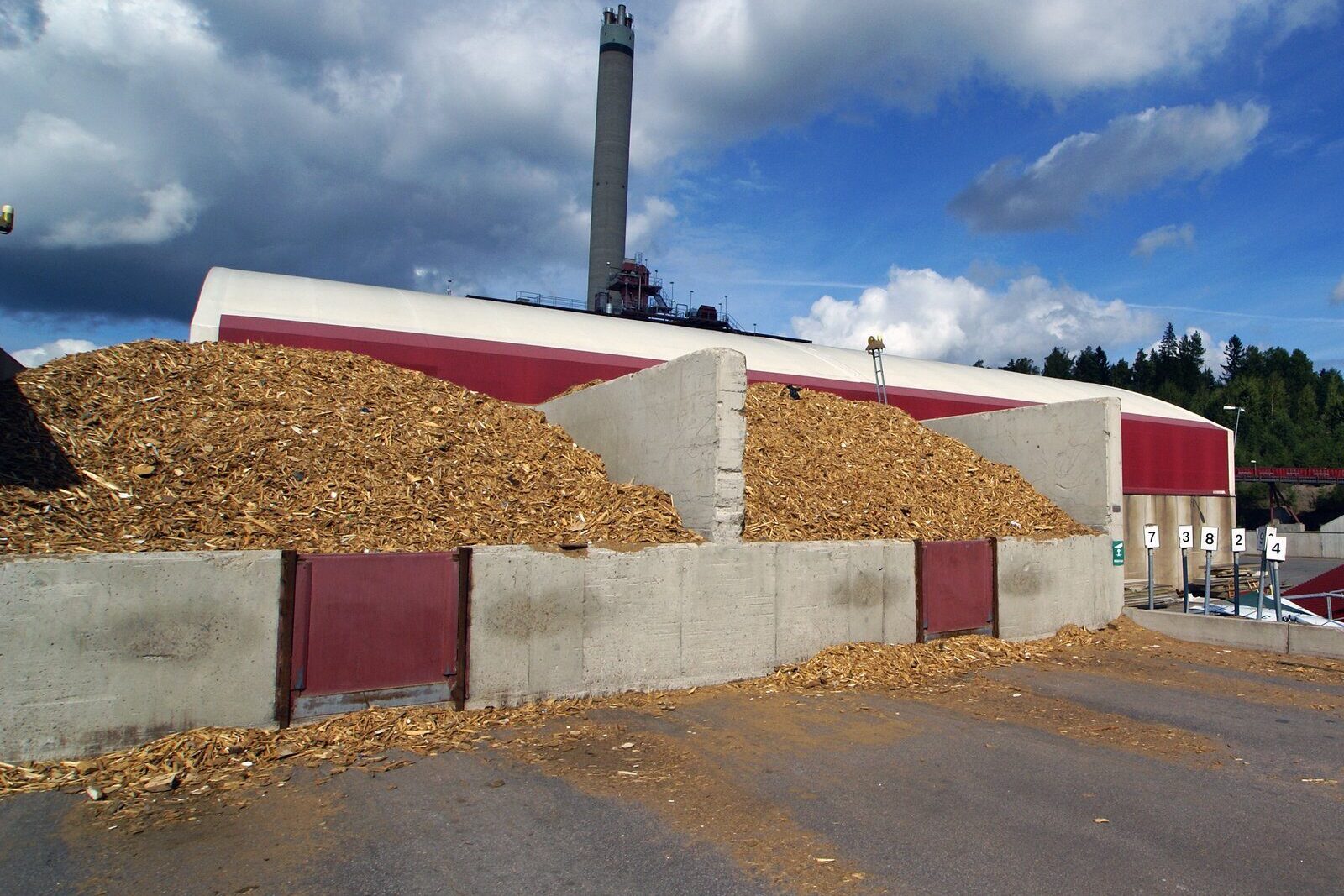
Many municipalities are currently planning how they will heat in future. In rural areas, biomass district heating is often an obvious choice: wood from forestry and landscape management is available locally, and the added value stays in the region.
- Base load and peak load: A pyrolysis plant covers the base load all year round. A peak-load boiler remains for cold winter days.
- More than heat: Unlike a simple wood chip boiler, pyrolysis also provides electricity and biochar.
- Use electricity or feed it in: Municipalities can feed the electricity into the grid under the EEG or use it in their own buildings, sewage treatment plants or pumping stations and so replace grid electricity.
- Funding: Federal funding is available for heating networks, for example through the Federal Funding for Efficient Heating Networks (BEW).
More on this on our Heating networks and municipalities page.
What determines profitability
Whether a plant pays off depends mainly on these points:
- Residues: Your own residues cost little or nothing, bought-in wood chips cost more. Fuel is often the largest cost item.
- Heat: The more heat you use throughout the year, the faster the plant pays off.
- Electricity: Used on site, it replaces grid power, currently around 18 ct/kWh or more for industry in Germany. Fed into the grid under the EEG, it earns around 12.5 ct/kWh.
- Biochar: It is usually the largest revenue item. The price depends on quality and buyer. pyropower can buy the biochar.
- CO₂ certificates: The carbon in the biochar can be certified as a carbon sink. According to IETA, prices range from 100 to 300 US dollars per tonne.
- Funding: Depending on the project, grants are possible. The example does not include any funding.
How a project works
- Initial call and profitability check: We calculate your project with your figures. The first check is free of charge.
- Test pyrolysis: On request, we check in advance how well your residue is suited.
- Pre-project phase: Site, permits, heat and power use, biochar offtake and funding in detail.
- Quotation: with the exact project price for your site.
- Construction and operation: Planning, construction and commissioning from a single source. The plant runs fully automatically with remote monitoring.
Frequently asked questions
What does biomass district heating cost a municipality?
In the example, around €3.5m net for the plant and boiler house, including storage, drying, discharge and project planning. The heating network itself is not included. We state the exact project price for your network in our quotation.
Does one Pyro-ClinX cover the entire heat demand?
It supplies the base load with up to 450 kW of heat. A boiler covers peaks, and several plants can be combined for larger networks.
Does the example apply to our municipality?
Not automatically. The example is highly simplified. Heat demand, fuel price, electricity price and biochar sales differ everywhere. We are happy to prepare a detailed calculation for your network on request.
- Pyrolysis plant at a sawmill: what it can cost and earn
- Biochar plant on a farm: what it can cost and earn
- Heating networks and municipalities: base load from regional residues
- Funding for pyrolysis plants 2026: programmes, opportunities and deadlines
- Pyro-ClinX: pyrolysis CHP for electricity, heat and biochar
Download
Pyro-ClinX brochure and data sheet
Technical data, feedstocks, products and the course of a project at a glance (PDF).
Download brochure (PDF)
 info@pyro-power.com
 +49 355 866 870 82
 pyropower GmbH