
Energy security for production.
[ Energy security ]
What keeps running in an outage, and what needs to happen first?
Starting point
Many disruptions do not start at the grid, but inside the plant. A transfer switch that has never been tested. A pump without backup power. A bottleneck nobody knows about.
Supply chain
What keeps running in an outage
We trace every supply route to the machine: power, gas, heat, cooling and compressed air. From outside, through the point of supply into the plant, all the way to the process.
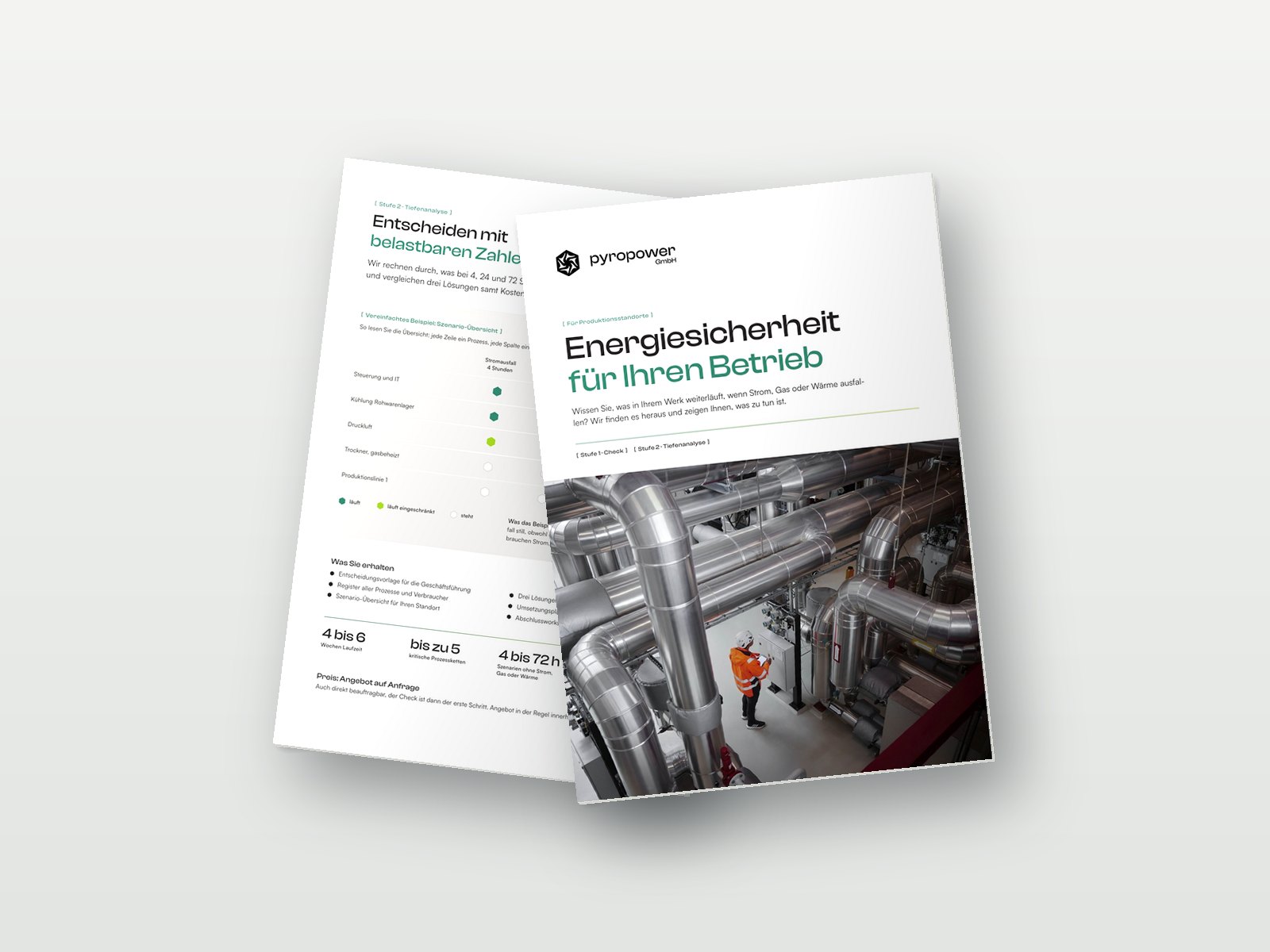
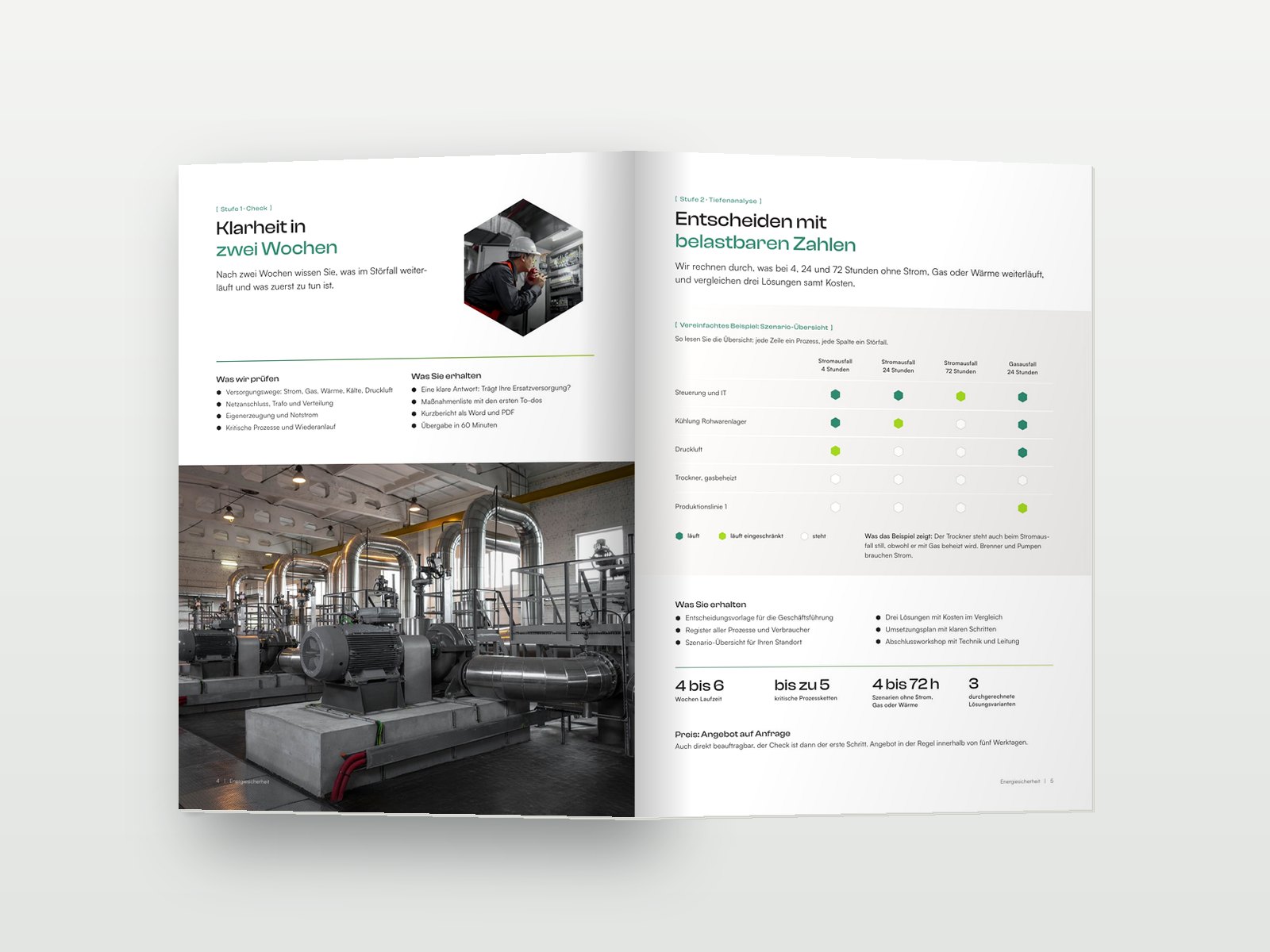
If the grid fails, the scenario overview shows line by line which process is still running, running at reduced capacity or stopped after 4, 24 and 72 hours. One example: the gas-fired dryer also stops during a power outage, because burners and pumps need electricity.
When it pays off
Four typical occasions
Secure operations
Backup power, PV or CHP are in place. But what do they supply in an emergency?
Reduce dependencies
Process heat depends on gas alone.
Review an investment
An electric boiler, heat pump or new transformer is coming up.
Provide evidence
Customers, insurers or banks are asking.
What we check
Every supply route to the machine
Supply routes: power, gas, heat, cooling, compressed air
We trace every route from the point of supply to the consumer, per medium, for your critical process chains (up to three). Backup and on-site supply are assessed based on your documents. The scope of the site is defined in writing.
Grid connection and distribution
Grid interconnection, transformer, medium voltage, main and sub-distribution, switching states and transfer points. Critical loads with power rating and starting behavior, generators, UPS systems, batteries and fuel reserves. The documents are checked against the actual installation.
Critical processes and loads
Production steps, batches and minimum throughput, minimum function per process, tolerable interruption and restart. Auxiliary loads such as pumps, controls and cooling are included, as is quality release after restart.
Interviews with plant management and engineering
Two interviews: one with plant management and one with maintenance and engineering together. Statements are checked against the documents. Contradictions are recorded, not smoothed over.
Optional on-site visit
A walk along the supply routes, not through the whole plant: nameplates, rated outputs, years of manufacture, backup supply, transfer switching and fuel storage. The result is a photo log and a list of deviations.
What is verified and what is only assumed
Every key statement in the report gets one of four labels: documented (stated in your documents or on the equipment), plausible (sound from an engineering standpoint, but not documented), tested (with date and conditions) or open (no reliable statement available). This way you know what you can rely on and where you need to follow up.
Short report, action list and handover
A short report of about five pages as Word and PDF files, written for management and engineering alike: the dependency chain per process, the prioritized gaps and an action list for the next steps, including the option of commissioning nothing further. Handover with plant management and engineering. No report for the filing cabinet: your maintenance team can start on it on Monday.
Result
A clear answer, first to-dos
You know what keeps running in an outage and what needs to happen first.
You get a clear answer on whether your backup supply holds up, an action list with the first to-dos and a short report as Word and PDF.
Two stages compared
Check or in-depth analysis
The Check gives the quick answer and the first to-dos. The in-depth analysis calculates scenarios and compares solutions when an investment is coming up. You can also start directly with the in-depth analysis; the Check is then its first step.
| Check | In-depth analysis | |
|---|---|---|
| Supply routes: power, gas, heat, cooling, compressed air | ✓ | ✓ |
| Grid connection, transformer and distribution | ✓ | ✓ |
| On-site generation and backup power | ✓ | ✓ |
| Critical processes and restart | ✓ | ✓ |
| Interviews with plant management and engineering | ✓ | ✓ |
| On-site visit | optional | ✓ |
| Action list with the first to-dos | ✓ | ✓ |
| Short report as Word and PDF | ✓ | ✓ |
| Detailed report | ✓ | |
| Scenarios: 4, 24 and 72 hours without power, gas or heat | ✓ | |
| Register of all processes and loads | ✓ | |
| Three solutions with costs compared | ✓ | |
| Implementation plan with clear steps | ✓ | |
| Decision paper and final workshop | ✓ |
[ Downloads ]
Energy security brochure
Risks, solutions and our approach from the check to the in-depth analysis, to share within your company. PDF, 1.5 MB.
Download brochure (PDF)FAQ
Frequently asked questions about backup power, backup supply and energy security

01 We already have an energy audit. Do we still need this?
Yes, because it answers a different question. Your audit shows where you can save energy. The Check shows what keeps running during a disruption. We use your existing audits and contingency plans for this, which saves you time and money.
02 Our grid practically never fails. Why should we have this reviewed?
The grid is rarely the problem. Most interruptions originate inside your own plant: a bottleneck, a transfer switch that has never been tested, a supplier who terminates a contract. The Check shows what your production can withstand in that case.
03 What belongs in a backup power concept for production?
Critical loads with power rating and starting behavior, transfer conditions, fuel autonomy, auxiliary media such as controls, cooling and compressed air, and a restart plan. A generator in the yard is not yet a concept.
04 How long does an industrial plant need to be able to bridge a power outage?
There is no general legal requirement. Germany’s Federal Office of Civil Protection and Disaster Assistance (BBK) recommends 72 hours without external refueling for critical infrastructure operators; for other businesses, the duration follows from the process. We assess 4, 24 and 72 hours as analysis horizons, not as a guarantee.
05 What happens to process heat if the gas supply fails?
That depends on whether there is an alternative heat supply and which operating states are permissible for how long. Often, both are missing from the documentation. The Check identifies which processes can run without gas and for how long, and where an alternative is missing.
06 Is a PV system with battery storage enough as a backup power supply?
Only if the system is capable of island operation and switching over to your critical loads has been technically verified. A high annual self-consumption rate says nothing about what runs during a disruption.
07 What proof of energy supply do customers, insurers or banks require?
Automotive customers under IATF 16949 require contingency plans that cover supply interruptions; insurers ask about precautions for business interruption coverage; banks ask about operational capability before financing. The Check provides an energy engineering record you can add to your documentation. It is not a certification.
08 Is the Check an expert report or a certification?
Neither, and that is intentional. The Check is an engineering review to support your decision. We evaluate your documents, talk with plant management and engineering and visit the plant if needed. Afterwards, you know what keeps running in an emergency and have an action list in hand. Measurements, load tests and official expert reports are not included. Where they would be worthwhile for you, the short report says so.
09 What will I have in hand after the Check?
A reliable answer to whether your backup supply holds up in an emergency. Plus the most urgent areas for action and first to-dos for your site. If your topic is smaller, we will tell you in the first conversation.
 info@pyro-power.com
 +49 355 866 870 82
 pyropower GmbH