
Biochar in metallurgy: biogenic carbon instead of coke and anthracite
14.07.2026
Biochar in metallurgy: biogenic carbon instead of coke and anthracite
Key facts in brief
Steel and metals need carbon: as an alloying element in the melt, as an energy carrier and for the foamy slag in the electric arc furnace. So far, it has mostly come from coke, anthracite or petroleum coke. Biochar in metallurgy is a biogenic alternative that research and industry are currently testing in trials.
- Around 12 kg of fossil carbon per tonne of steel is used in the electric arc furnace. According to a review study, it causes 40 to 70 percent of the furnace’s direct emissions.
- In an industrial trial, a third of the fossil charge carbon was replaced by a low-ash briquette of biogenic carbon, without deviation from normal operation.
- What matters is high fixed carbon, low ash and volatiles, and suitable density and grain size.
- In metallurgy, the carbon is released again. Here biochar replaces fossil carbon; no long-term sink is created.
Lucie Töpfer
Managing Director, pyropower GmbH

Three tasks for carbon in the furnace
In the electric arc furnace, carbon has several roles. As charge carbon, it is charged with the scrap, raises the carbon content of the melt and supplies chemical energy, which contributes 15 to 25 percent of the furnace’s total energy input. As injection carbon, it reacts with iron oxide in the slag to form carbon monoxide. The gas bubbles make the slag foam, and this foamy slag envelops the arc and protects the furnace wall.
Around 12 kg of fossil carbon per tonne of steel is used for this (DiGiovanni and Echterhof, Journal of Sustainable Metallurgy, 2024). In addition to the electric arc furnace, the Austrian research project Biochar4Metallurgy is also investigating shaft and cupola furnaces, secondary copper metallurgy and foundries. The aim is to replace fossil carbon carriers in melting processes with biogenic carbon.
Quality criteria for the furnace
Fossil carbon carriers are very uniform in composition. For metallurgical processes, biochar has to meet several criteria that depend heavily on raw material and production:
- Fixed carbon: Pyrolysis biochar usually reaches over 70 percent, in some cases close to 90 percent. It determines how much carbon actually reaches the melt.
- Volatile matter: For charge carbon, it should be low because it affects off-gas volume and energy balance.
- Ash: Clean biomass is usually below 5 percent. Ash affects slag and steel chemistry and depends mainly on the raw material.
- Sulphur and phosphorus: Biogenic carbon usually contains less sulphur but often more phosphorus. This can require additional dephosphorisation.
- Density and reactivity: Biochar is considerably lighter and more reactive than fossil carbon. It can remain on the slag or be captured by the off-gas system. Briquetting and agglomeration are considered a solution.
Trials point to partial substitution
The review by DiGiovanni and Echterhof summarises laboratory, pilot and industrial trials. In pilot trials, biogenic charge carbon did not adversely change steel and slag chemistry, and the sulphur content fell. In a 50-tonne furnace, a low-ash briquette replaced a third of the fossil carbon in three heats without deviation from normal operation. Mixtures of equal parts biogenic carbon and coke achieved similar results to pure coke in foaming trials.
Complete one-to-one replacement requires high-quality biochar. In practice, gradual partial substitution is therefore emerging. Uniform quality criteria for use in melting processes are being developed by Biochar4Metallurgy, among others, which runs until November 2026.
Biogenic carbon from regional residues
In metallurgy, the carbon does not remain bound; it becomes CO₂ again in the process. Here biochar replaces fossil carbon, so no CO₂ sink and therefore no sink certificate is created. The carbon then comes from renewable residues instead of fossil deposits, however.
pyropower produces biochar in the Pyro-ClinX in line with the EBC standard, from woody residues, with documented origin and regular laboratory analyses. Laboratory tests and pilot operation clarify whether it suits a metallurgical process. We provide analyses and data sheets on request. For metal businesses with high-temperature waste heat, ClinX Heat also offers a way to convert this heat into power.
- Biochar in environmental technology and industry: fields of application and quality
- Biochar: EBC classes, applications and ordering
- ClinX Heat: power from high-temperature waste heat
- Power and heat from wood: energy concept for a metalworking company
- Biochar production at an industrial site: three Pyro-ClinX in Mecklenburg-Western Pomerania
Download
Pyro-ClinX brochure and data sheet
Technical data, feedstocks, products and the course of a project at a glance (PDF).
Download brochure (PDF)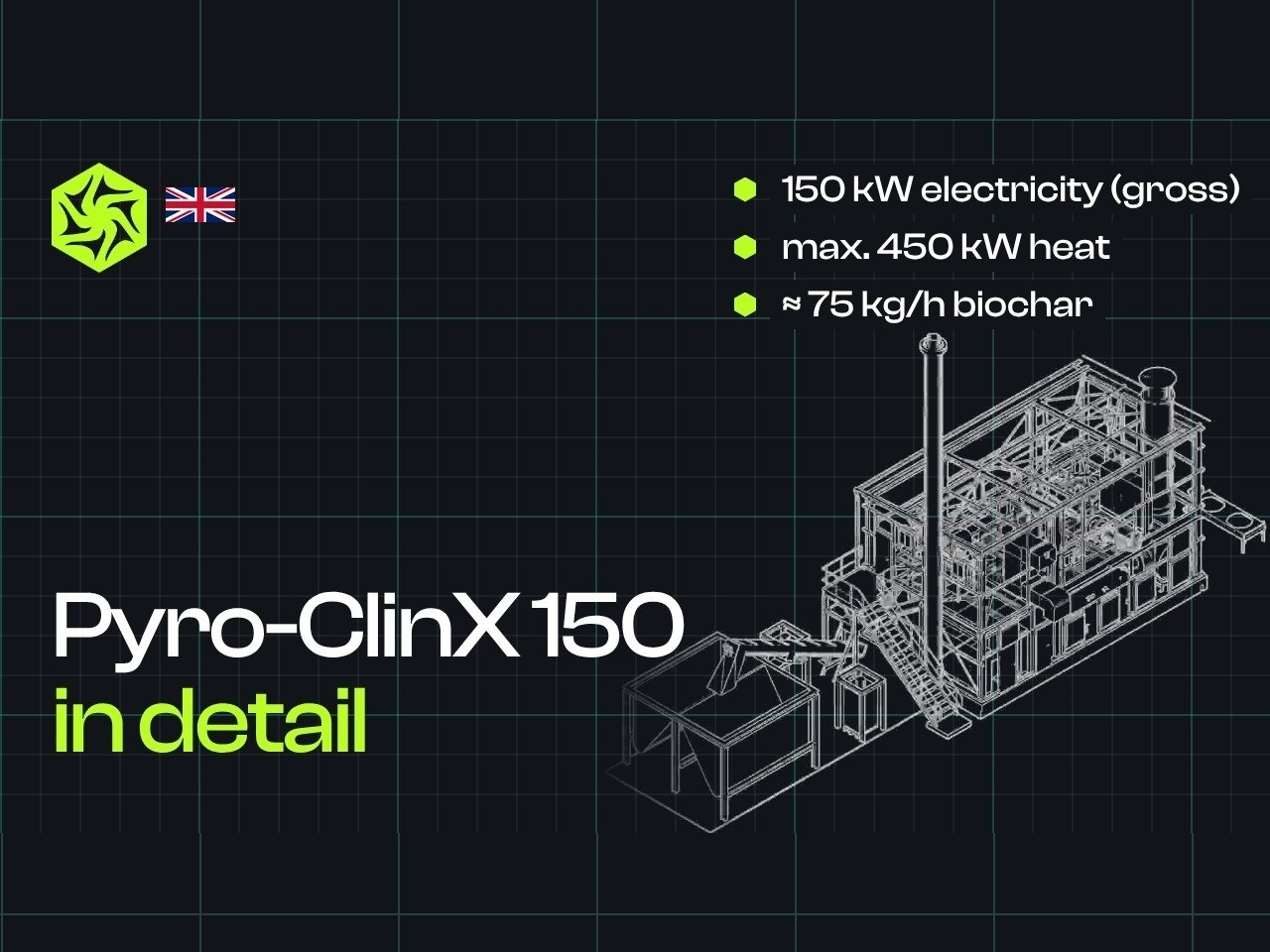

 info@pyro-power.com
 +49 355 866 870 82
 pyropower GmbH