
Energy supply for hospitals and care homes: base-load heat from wood residues

12.11.2026
Energy supply for hospitals and care homes: base-load heat from wood residues
In short: A hospital needs around 25,000 kWh of heat and 6,000 to 10,000 kWh of electricity per bed and year, every day of the year. Most German hospitals heat with natural gas, and many are making losses. This article shows where a pyrolysis plant supplying base-load heat, electricity and biochar can be one building block, what it does not replace and which funding is available today.

Lucie Töpfer
Managing Director, pyropower GmbH

Key points
- Per bed, hospitals need three to four times as much heat as electricity, in summer too.
- According to 2019 data, around 92 % of German hospitals heated with natural gas.
- For a hospital with 300 beds, one Pyro-ClinX can cover between a third and almost half of the heat demand by calculation. It does not replace the emergency power supply.
- There is currently no dedicated federal programme for energy and climate protection in hospitals. General programmes such as the KfW heating subsidy can be used.
The energy demand of a hospital
According to a paper by the Research Services of the German Bundestag, a hospital uses 6,000 to 10,000 kWh of electricity and 25,000 to 29,000 kWh of heat per bed and year. A report commissioned by the German Hospital Federation (DKG) puts the figures at 7,800 kWh of electricity and 25,000 kWh of heat. A hospital with 300 beds therefore needs around 7,500 MWh of heat a year.
Heat is not only needed in winter: hot water, sterilisation, kitchen, laundry and ventilation run all year round. On top of this comes cooling for operating theatres, laboratories and medicines. Most hospitals heat with natural gas, around 92 % according to 2019 data from the German Hospital Institute (DKI).
Costs and security of supply
The financial situation is tight: according to the DKI Hospital Barometer, around two thirds of German hospitals made a loss in 2024, and around 70 % expected a loss for 2025. Every kilowatt hour that does not have to be bought in eases the budget.
At the same time, security of supply is gaining attention. According to the same survey, only 43 % of hospitals can bridge a power outage of at least three days. Germany’s new KRITIS umbrella act adds resilience obligations for large hospitals. Generating energy on site reduces dependence on gas supplies. It does not replace the mandatory emergency power supply. How sites can secure a more independent supply is shown on our page on energy security.
Where a pyrolysis plant fits
A Pyro-ClinX 150 produces up to 450 kW of heat, 150 kW of gross electrical output and biochar from wood chips. At 8,000 operating hours, that is up to 3,600 MWh of heat and around 1,200 MWh of gross electricity a year. If the plant dries moist wood chips itself, around 2,600 MWh of this heat remains usable. In a hospital it can:
- cover the base load for hot water, heating and ventilation, with the existing boiler covering peaks,
- supply process heat up to 360 °C via thermal oil, for example for steam, depending on the design,
- provide heat for an absorption chiller in summer,
- generate electricity for own use. In a hospital with 300 beds, electricity demand is well above generation, so all the power is used in-house.
For a hospital with 300 beds, one plant can therefore cover between a third and almost half of the heat demand by calculation. How much is actually used depends on the annual heat load profile. If heat is the main need, the Pyro-Hex 315 with around 750 kW of heat is an option. For care homes and smaller hospitals, a cluster with neighbouring buildings or a small heating network can make sense.
On site, the plant needs space for itself and the fuel store, plus access for around three truck deliveries a week. It runs fully automatically with remote monitoring.
Funding in Germany: what exists and what does not
There is currently no dedicated federal programme for energy and climate protection in hospitals. The Hospital Transformation Fund, with up to €50 billion from 2026 to 2035, serves to implement the hospital reform. Energy and climate protection are not explicitly among its purposes, and applications are made by the federal states. The DKG is therefore calling for a dedicated investment programme for climate-resilient hospitals.
General programmes can be used:
- the heating subsidy under the Federal Funding for Efficient Buildings (KfW 522), also for non-profit operators,
- the Cooling and Air Conditioning Directive for efficient cooling systems, for which hospitals can also apply, with applications until 31 December 2026,
- the Federal Funding for Energy Efficiency in Industry (Module 2), if more than half of the heat is used in processes.
Which programmes suit a hospital and how they can be combined is something we check in the pre-project phase. An overview is given in our article Funding for pyrolysis plants 2026.
Frequently asked questions
How much heat does a hospital need per bed?
Around 25,000 to 29,000 kWh a year, plus 6,000 to 10,000 kWh of electricity.
Can a pyrolysis plant replace the emergency power supply?
No. The mandatory emergency power supply for medical areas remains necessary. On-site generation supplements the supply in normal operation and reduces dependence on gas.
Does a plant also suit a care home?
For a single smaller facility, a Pyro-ClinX is usually too large. It makes sense in combination with other buildings or a heating network.
Is there funding from the Hospital Transformation Fund?
Energy and climate protection are not explicitly among its funding purposes. General programmes such as the KfW heating subsidy or the Cooling and Air Conditioning Directive can be used.
- Energy security: a more independent supply for your site
- Energy security for production sites: which technologies support a secure supply
- Funding for pyrolysis plants 2026: programmes, opportunities and deadlines
- Economics of a pyrolysis plant: revenues, savings and key levers
Sources
- Research Services of the German Bundestag (2023): energy consumption of hospitals, WD 5-059-23. bundestag.de
- Report commissioned by the German Hospital Federation (2025) on financing options for climate protection in hospitals. kgnw.de
- German Hospital Institute: data on heating types 2019, reported in Ärzte Zeitung on 19 July 2022.
- German Hospital Institute (2025): Hospital Barometer, reported in Deutsches Ärzteblatt on 29 December 2025.
- Görg Rechtsanwälte (2026): KRITIS umbrella act, 9 March 2026. goerg.de
- Federal Office for Social Security (2026): Hospital Transformation Fund, overview. bundesamtsozialesicherung.de
- German Hospital Federation (2026): press release of 29 June 2026 on the special fund. dkgev.de
- KfW: heating subsidy for non-residential buildings (522). kfw.de
- Federal Environment Ministry (2026): announcement on the Cooling and Air Conditioning Directive, 15 June 2026.
- BAFA: Federal Funding for Energy Efficiency in Industry, Module 2. bafa.de
Download
Pyro-ClinX brochure and data sheet
Technical data, feedstocks, products and the course of a project at a glance (PDF).
Download brochure (PDF)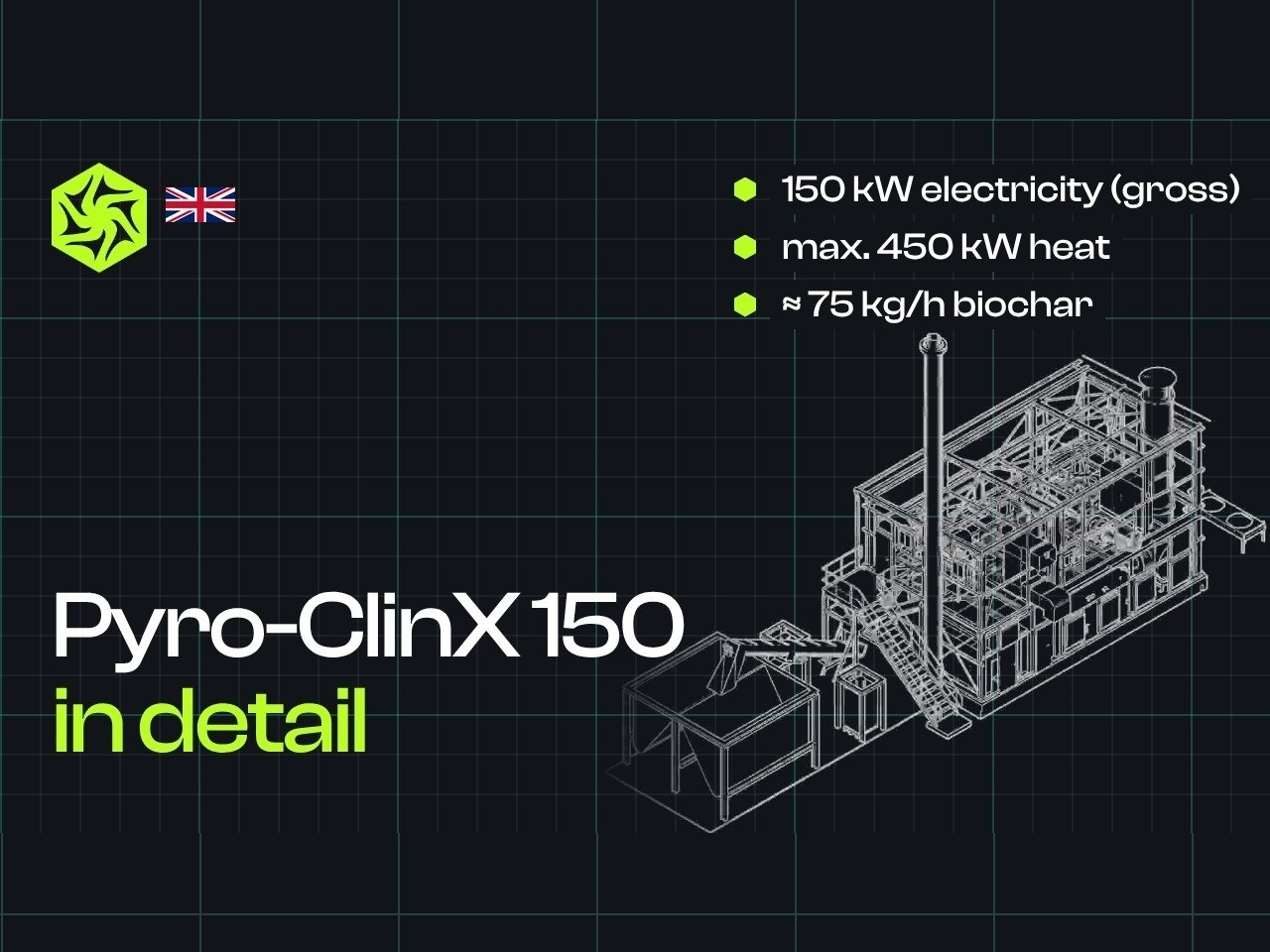
 info@pyro-power.com
 +49 355 866 870 82
 pyropower GmbH