
Pyrolysis Plant Costs: Investment, Operation and Everything in Between

31.10.2026
Pyrolysis Plant Costs: Investment, Operation and Everything in Between
A pyrolysis plant is an investment in four revenue streams: your own electricity, usable heat, biochar and CO₂ removal certificates. How large the investment turns out depends less on the plant itself than on how it is integrated into the site: fuel storage, heat pipes, grid connection, buildings and permits. This article shows what the plant brings in, which items arise in investment and operation, and which levers help to shape the budget.

Sebastian Kießling
Managing Director Technology, pyropower GmbH

Key facts
- Four returns offset the costs: your own electricity, process heat, biochar and CO₂ removal certificates, over 15 to 20 years of operation.
- Besides the core plant, the investment covers fuel logistics, heat integration, grid connection, construction and permits. Existing infrastructure noticeably reduces the effort.
- Operation is manageable: the plant runs fully automatically, and your own residues reduce the fuel item.
- We provide indicative prices on request. The pre-project phase delivers a reliable figure for your site at a fixed price.
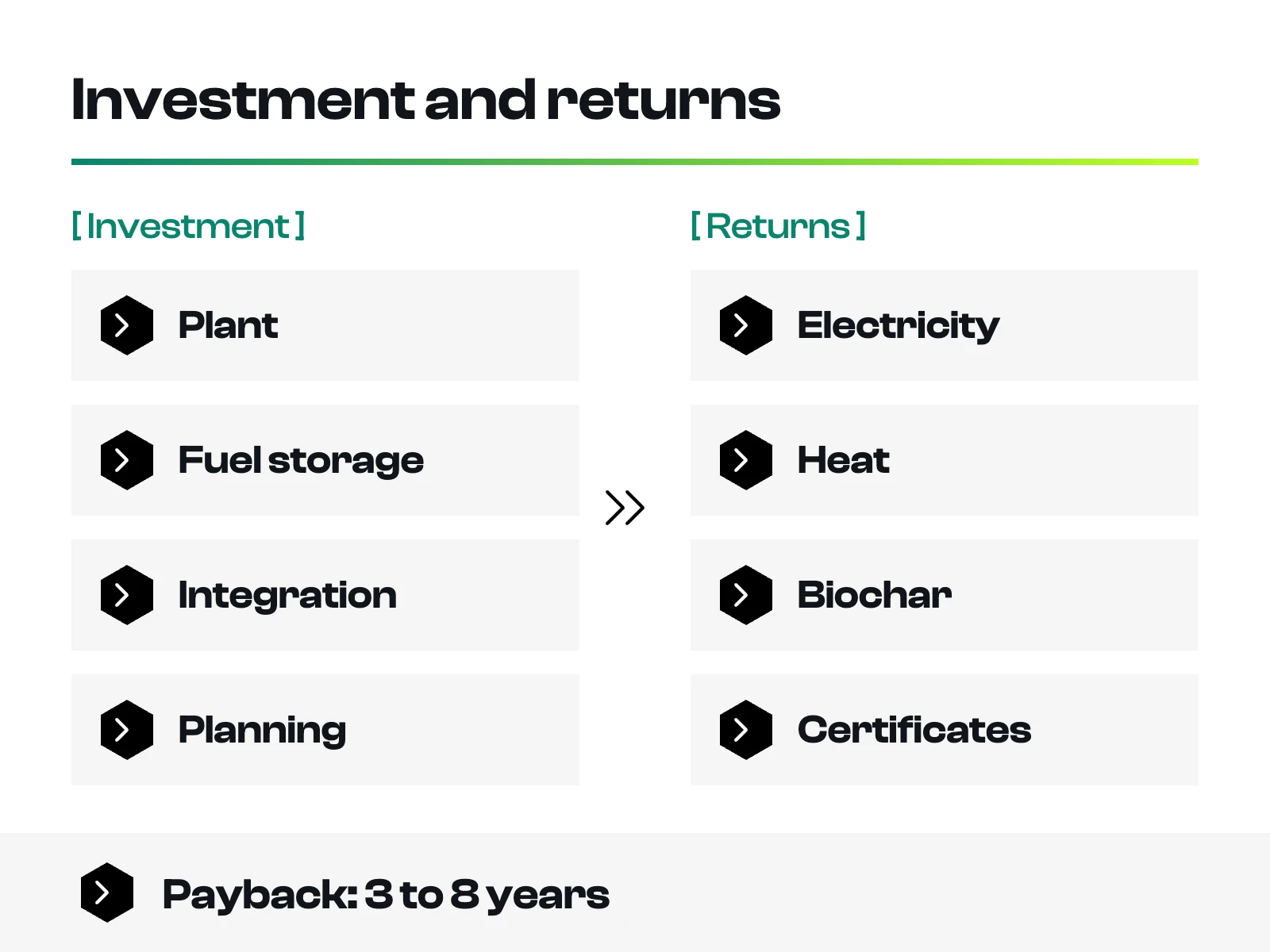
What the investment brings in
Before looking at individual items, it is worth looking at the other side of the calculation. A Pyro-ClinX produces four values from woody residues at the same time:
- Electricity: 150 kW electrical (gross), around the clock, for your own use or for feed-in.
- Heat: max. 450 kW thermal, as process heat up to 360 °C for production, drying or heating.
- Biochar: around 75 kg per hour (dry matter), for your own use or for sale.
- CO₂ removal certificates: additional revenue if the carbon remains bound in its application and its whereabouts are documented.
On top of that come more predictable energy costs: fuel can be secured through your own residues or regional supply contracts instead of buying electricity and gas at fluctuating market prices. On request, pyropower takes over the biochar and certificates, so operations can focus on power and heat. How these returns add up in euros is shown in the article Economics of a pyrolysis plant.
Investment: the items at a glance
The investment in a pyrolysis plant consists of several blocks. The core plant with reactor, gas utilisation and power generation is the visible part. Alongside it are items that, depending on the site, are hardly noticeable or shape the budget.
| Item | What it includes | Depends on |
|---|---|---|
| Core plant | Pyrolysis reactor, gas utilisation, power generation, control system | Output class, number of units |
| Fuel logistics | Storage, moving floor or bunker, conveyors, drying if required | Fuel quantity, moisture content, delivery |
| Heat integration | Heat exchanger, buffer storage, pipes to the consumer | Temperature level, distance, existing heating |
| Electrical integration | Switchgear, meters, transformer and grid connection if required | Self-consumption or feed-in, grid situation |
| Construction | Foundation, enclosure or hall, fire protection, access | Existing areas and buildings |
| Biochar | Discharge, big bag filling station, storage area | Quantity, marketing |
| Planning and permits | Planning, expert reports, application documents | Permit route, site |
| Commissioning | Installation, commissioning, performance test, training | Scope of contract |
For many businesses, what already exists does not need to be built again. With free hall space, an existing heating circuit and a sufficient grid connection, the investment focuses mainly on the plant and the fuel storage. On an empty plot, foundation, enclosure, pipes and grid connection are added.
Operation: running costs at a glance
Operating costs arise over the entire service life. An industrial plant is designed for 15 to 20 years of operation, so it pays to plan for them from the start.
| Item | What it includes | Lever |
|---|---|---|
| Fuel | Purchase and delivery of wood chips | Own residues, supply contracts, moisture content |
| Maintenance and service | Inspections, wear parts, remote monitoring | Service contract, operating hours |
| Staff | Inspection rounds, fuel acceptance, filling the biochar | Automation, integration into existing shifts |
| Own consumption | Power for conveyors, fans and control system | Design of auxiliary units |
| Insurance | Machinery and business interruption insurance | Site, fire protection concept |
| Measurements and records | Emission measurements, biochar analyses, certification | Permit conditions, marketing route |
| Financing | Interest and repayment | Equity, development loans |
Day-to-day effort is manageable. The Pyro-ClinX runs fully automatically, is monitored remotely and maintained in three service levels. On site, the main tasks are inspection rounds, accepting fuel and filling the biochar, tasks that fit well into existing routines. With your own residues, fuel purchasing is no longer needed, and often disposal as well.
Five levers for the budget
- Choose the right fuel: the Pyro-ClinX processes wood chips with up to 25 % moisture content directly. An optional module is available for wetter material.
- Use what is there: free hall space, an existing heating circuit and a sufficient grid connection noticeably reduce ancillary costs.
- Use the standard design: it delivers process heat up to 360 °C, and a special design up to 550 °C.
- Bundle units: several units at one site share fuel storage, integration and planning.
- Clarify permits early: we already assess the likely permit route during the pre-project phase.
Plan these items in from the start
A complete budget from the outset avoids later additions. These items belong in it:
- Grid connection and metering concept if power is fed in or supplied to third parties.
- Heat pipes to the consumer if plant and heat demand are not next to each other.
- Backup for maintenance periods, when a boiler or grid supply steps in.
- Biochar analyses and certification if the biochar is to be sold in line with the EBC standard or credited as a CO₂ sink.
- Time for permits and the grid operator in the project plan, so the start of revenues is planned realistically.
For an initial overview, we are happy to provide indicative prices on request. The figure becomes binding once residue, heat demand and infrastructure are on the table. That is also when it becomes clear what the plant brings in at the site.
Lucie TöpferManaging Director, pyropower GmbH
From indicative price to a reliable figure
Indicative prices, which we provide on request, give a first point of reference. A price per kilowatt alone, however, says little about pyrolysis plants, because plants deliver different products and are offered with different scopes of supply. More on this in the article Seven criteria for choosing a pyrolysis plant. A calculation becomes reliable when it is based on site data:
- quantity and moisture content of the residue
- electricity and heat load profile over the year
- existing infrastructure such as hall, heating circuit and grid connection
- permit situation at the site
At pyropower, this is the task of the pre-project phase. Using your company figures, it clarifies whether the system suits the site and when it pays for itself. A funding check is included at no extra cost. You receive a fixed-price offer for it, and if you then commission the plant, the cost of the pre-project phase is credited.
Conclusion
The costs of a pyrolysis plant consist of the plant, its integration into the site and operation over many years. They are offset by your own electricity, process heat, biochar and CO₂ removal certificates, and typical payback periods are between 3 and 8 years, depending on the site. Collecting all items early lets you compare offers on the same basis and quickly shows which levers work at your own site. Indicative prices and an initial conversation about your site are available on request. How costs and returns combine into a result is shown in the article Economics of a pyrolysis plant. The funding overview explains which programmes support the investment.
Frequently asked questions
What does a pyrolysis plant cost?
We provide indicative prices for the Pyro-ClinX on request. The exact investment depends on the site, in particular on fuel logistics, heat integration, grid connection and construction. The pre-project phase turns this into a reliable cost estimate with an economic assessment.
What does a pyrolysis plant bring in?
Electricity, heat, biochar and CO₂ removal certificates. How much of this arrives in euros depends mainly on energy prices, heat use and operating hours. Typical payback periods are between 3 and 8 years. The article on economics shows the levers.
What running costs arise during operation?
Fuel, maintenance and service, staff for inspection rounds and fuel acceptance, power for own consumption, insurance as well as measurements and records. The plant runs fully automatically. With your own residues, the fuel item falls because purchasing and often disposal costs no longer apply.
Is drying worthwhile for wet wood chips?
It is worthwhile if no other suitable fuel is available and heat for drying is on hand. The Pyro-ClinX processes wood chips with up to 25 % moisture content directly, and an optional module is available for wetter material.
Are several small plants more expensive than one large one?
Not necessarily. Several units at one site share storage, integration and planning, and while one unit is being serviced, the others keep running. Whether one or several units fit depends on the base load.
Which funding is available for the investment?
In Germany, payments under the EEG or KWKG are possible for electricity from biomass, the BEW for heat networks, the GRW for the investment depending on the region, and the KfW loan Renewable Energies Standard for financing. A funding check is included in the pre-project phase at no extra cost. The funding overview explains the programmes.
Download
Brochure and data sheet Pyro-ClinX
Technical data, feedstocks, products and project steps at a glance (PDF).
Download brochure (PDF)

 info@pyro-power.com
 +49 355 866 870 82
 pyropower GmbH