
Outlook 2027: deadlines and rules for companies with residues and waste heat

02.11.2026
Outlook 2027: deadlines and rules for companies with residues and waste heat
Key facts at a glance
Anyone wanting to use residues and waste heat economically in 2027 should know a number of deadlines and ongoing legislative procedures. We have compiled what is fixed as of today (end of October 2026) and what is still in draft.
- CO₂ price: The national price for fuels is to remain in the corridor of 55 to 65 euros per tonne in 2027. The EU emissions trading system for buildings and transport starts in 2028.
- Heat planning: Large cities have submitted their heat plans, all other municipalities follow by 30 June 2028.
- Waste heat: An amendment to the Energy Efficiency Act is to restrict the reporting obligation for waste heat to large consumers.
- Biomass and carbon removal: Stricter evidence under RED III, and an EU methodology has applied to biochar since May 2026.
- Wastewater: Germany must transpose the new Urban Wastewater Treatment Directive by 31 July 2027.

Sebastian Kießling
Managing Director Technology, pyropower GmbH

CO₂ price 2027: another year in the corridor
The German government has introduced the draft of a third act amending the Fuel Emissions Trading Act in the Bundestag. Under it, the CO₂ price for petrol, diesel, heating oil and natural gas is to remain in a corridor of 55 to 65 euros per tonne in 2027 as well. The background is the postponement of the EU emissions trading system for buildings and road transport (ETS2) from 2027 to 2028.
For companies that currently generate heat with natural gas or heating oil, the price path from 2028 remains open. This is a reason to look early at alternatives based on their own residues or existing waste heat.
Heat plans and new rules for waste heat
Under the Heat Planning Act, cities with more than 100,000 inhabitants had to submit their heat plans by 30 June 2026, while smaller municipalities have until 30 June 2028. In 2027 many municipalities will therefore be working on their plans. For companies with waste heat or woody residues, this is an opportunity to get involved as a heat source.
An amendment to the Energy Efficiency Act is before the Bundestag. In future, the obligation to report to the waste heat platform is to apply only to companies with an annual consumption of more than 23.6 GWh and to data centres from 1 MW. So far, companies from 2.5 GWh are affected and report annually by 31 March. Until the amendment is passed, the current law applies. High-temperature waste heat can be converted into power and heat with ClinX Heat.
Stricter evidence, new certificates
The EU Renewable Energy Directive RED III lowers the threshold for sustainability and greenhouse gas evidence for solid biomass from 20 to 7.5 MW rated thermal input. For power generation, Germany implements this through the Biomass Electricity Sustainability Ordinance, whose draft was with the European Commission for notification until 15 October 2026. The number of plants covered is likely to roughly double, and demand for certified forest wood is likely to rise.
For carbon removals, the EU methodology for biochar under the CRCF Regulation has applied since 7 May 2026. Certification schemes can now apply for recognition. The first EU-certified units from carbon removals could be issued at the end of 2026 or in 2027. The Commission plans a methodology for carbon storage in buildings by the end of 2026.
Urban wastewater: transposition by July 2027
The Urban Wastewater Treatment Directive (EU) 2024/3019 entered into force on 1 January 2025 and must be transposed into German law by 31 July 2027. Treatment plants from 150,000 population equivalents will in future need a fourth treatment stage for micropollutants, and in risk areas this also applies to plants from 10,000 population equivalents. Extended producer responsibility, under which manufacturers of pharmaceuticals and cosmetics bear at least 80 percent of the costs, must be in place by 1 January 2029. In addition, there are energy audits and a target path towards energy neutrality of wastewater treatment by 2045.
For wastewater associations, energy and sewage sludge are thus moving higher up the planning agenda. Biochar is being tested as an adsorbent for micropollutants, and the pyrolysis of sewage sludge is an option that we have planned for an association in Brandenburg.
- ClinX Heat: power and heat from high-temperature waste heat
- Residue check: assessing residues technically and economically
- Energy security: making production sites more independent
- The fourth treatment stage: biochar against micropollutants in wastewater
- Sewage sludge pyrolysis: project planning for a water and wastewater association
Download
Brochure and data sheet Pyro-ClinX
Technical data, feedstocks, products and project steps at a glance (PDF).
Download brochure (PDF)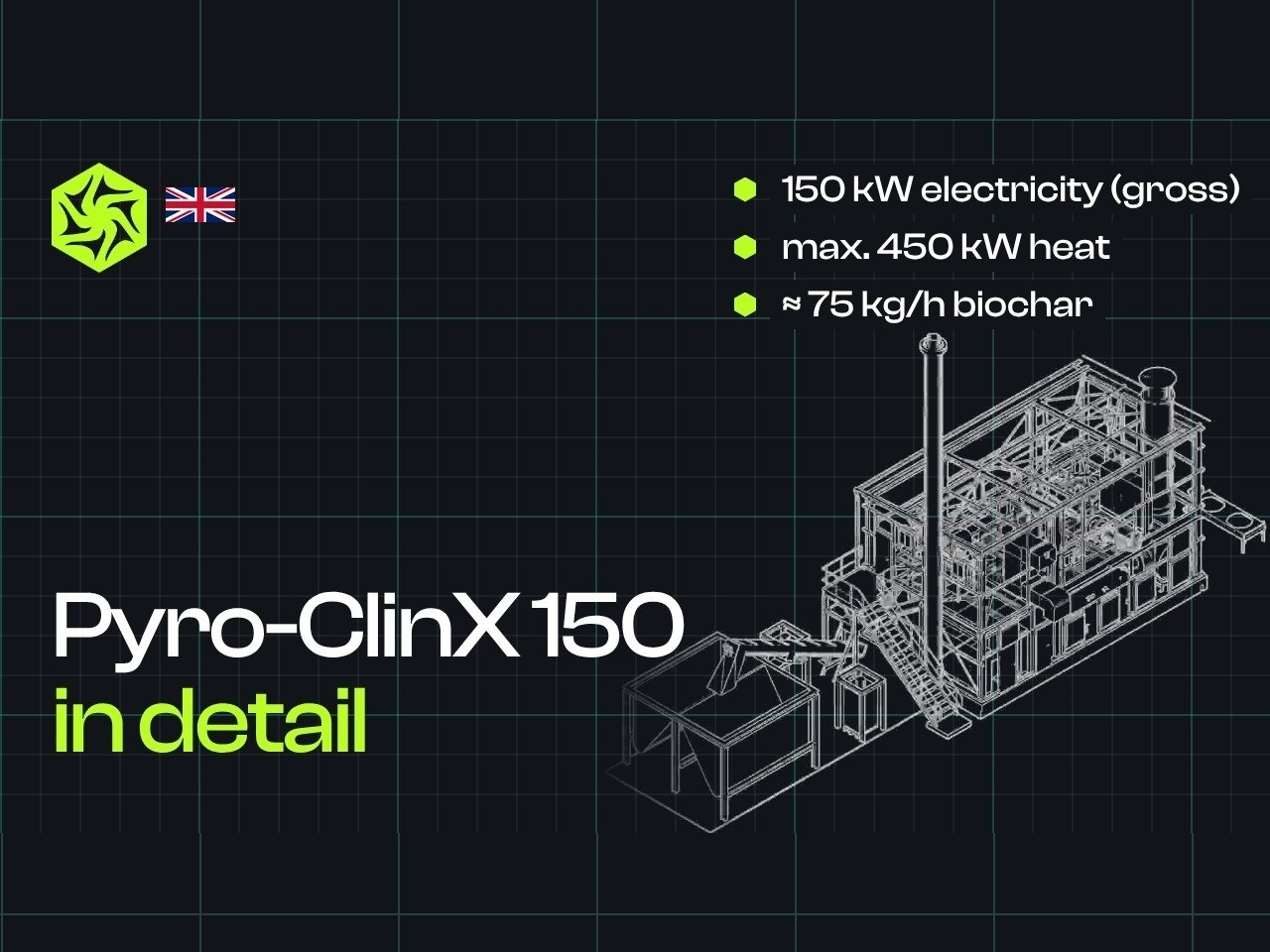
 info@pyro-power.com
 +49 355 866 870 82
 pyropower GmbH