
Dry bedding, less ammonia: biochar in the barn
22.09.2026
Dry bedding, less ammonia: biochar in the barn
Barn climate starts at floor level
Damp bedding, ammonia in the air and inflamed footpads are recurring issues in poultry and cattle farming. In this context, biochar is often mentioned as a bedding additive. The studies show that it can help, but only if used correctly.
Key facts in brief
- Mixed into the bedding, biochar reduced ammonia in laboratory trials by about a quarter to almost half.
- Sprinkled loosely on top, it showed no significant effect.
- In a practical trial with organic broilers, there was no effect because the animals quickly scratched the biochar into the litter.
- Dry bedding remains the most important lever for the barn climate.
- The biochar moves with the bedding into the manure and on to the field.

Lucie Töpfer
Managing Director, pyropower GmbH

Where the ammonia in the barn comes from
Ammonia is produced when urea from urine and faeces is broken down by enzymes. The damper and warmer the bedding, the faster this process runs. The gas irritates the airways of animals and people, worsens the barn climate and is lost as nitrogen for the fertiliser. Biochar can intervene at two points: it absorbs moisture and binds ammonium on its surface before it escapes as gas. For this to work, it has to be where the ammonia is produced, i.e. in the bedding and not on top of it.
Binding ammonia
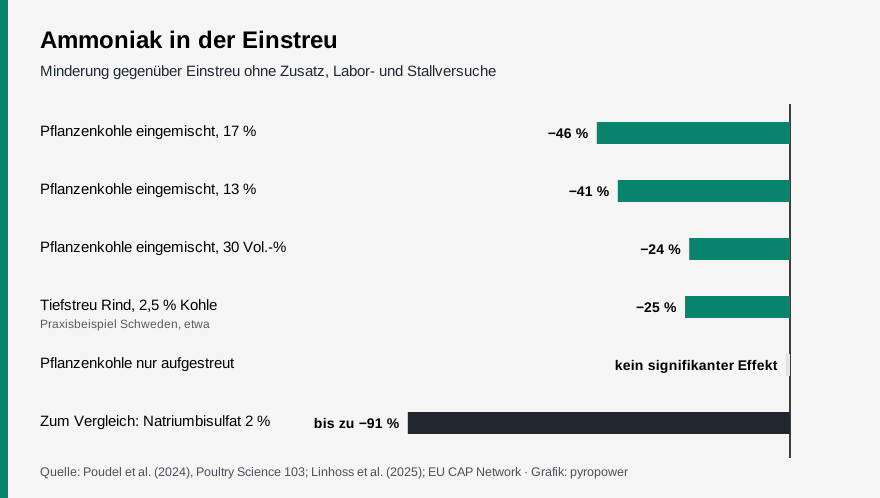
In a 2024 laboratory trial published in Poultry Science, 13 and 17 percent biochar in broiler litter reduced ammonia by 41 and 46 percent. Another trial from 2025 compared mixing in and sprinkling on top: mixed in, ammonia fell by around 24 percent; sprinkled on top, there was no significant effect. For comparison: acid-based litter amendments such as sodium bisulphate reduced ammonia considerably more in the same trials. Biochar is therefore not a substitute for such additives, but it can have a complementary effect and brings carbon into the cycle.
An honest practical trial
From 2020 to 2023, the University of Kassel tested in an Operational Group with around 8,500 organic broilers whether biochar in the bedding helps in the cool season. The result: no measurable effect on footpads, bedding moisture or ammonia. The animals had quickly scratched the biochar into deeper layers. The biochar also absorbed moisture in storage. The most important recommendation from the project therefore concerns not the biochar but the bedding itself: its moisture should stay below 35 percent.
Deep litter and compost barns
In a Swedish practical example with fattening bulls on deep litter, ammonia emissions fell by about a quarter with 2.5 percent biochar relative to the manure. Higher quantities brought no additional benefit. In the subsequent biogas plant, the manure supplied more methane. In simulated compost barns for dairy cattle, ammonia and nitrogen losses fell considerably, but only for one to two weeks. The biochar therefore has to be topped up regularly.
Study in focus
An honest practical trial from Hesse
Operational Group CAReFUL, University of Kassel, 2020 to 2023
- Around 8,500 organic broilers in nine production cycles.
- Biochar at 250 grams per square metre every two weeks.
- No effect on footpads, bedding moisture or ammonia.
- Main reason: the animals quickly scratched the biochar into deeper layers.
Practical tips
- Mix in instead of sprinkling on top: The biochar works in the bedding, not on it.
- Dose sufficiently: Small sprinkled quantities have little effect. Get advice on quantity and interval.
- Store dry: Damp biochar loses absorption capacity and clumps.
- Basics first: Ventilation, drinkers and stocking density determine bedding moisture.
- Think in cycles: With the bedding, the biochar gets into the manure. There it works particularly well during composting.
Talk to us
Would you like to use biochar in your business or your product? We advise you on quality, grain size and quantity and provide samples. Feel free to use our contact form or request biochar directly in an XXL big bag .
Frequently asked questions answered briefly
Does the bedding need a certain quantity of biochar?
The trials worked with very different quantities, from a few hundred grams per square metre up to several percent of the bedding. The biochar was effective above all when a significant quantity was mixed in.
Are there results for poultry, cattle and pigs?
Most data come from poultry farming. For cattle on deep litter there are practical examples, for pigs fewer studies.
Can biochar be combined with other bedding additives?
Biochar can be combined with other bedding additives. Acid-based products work more strongly against ammonia, while biochar also brings carbon into the cycle.
Sources
Poudel et al. (2024): Biochar in broiler litter. Poultry Science 103
Linhoss et al. (2025): Mixing in and top-dressing biochar in broiler litter (abstract)
OG CAReFUL, University of Kassel (2023): Practical information sheet
EU CAP Network: Biochar on a beef fattening farm with biogas plant
Shin et al. (2025): Biochar in the compost barn. Applied Sciences 15
We summarise the results in our own words. Figures are averages or individual results from the studies mentioned and cannot simply be transferred to every site.
Download
Brochure and data sheet Pyro-ClinX
Technical data, feedstocks, products and the course of a project at a glance (PDF).
Download brochure (PDF)

 info@pyro-power.com
 +49 355 866 870 82
 pyropower GmbH