
Carbon in buildings: how it is accounted for
12.08.2026
Carbon in buildings: how it is accounted for
Carbon stores need proof
Biochar in building materials stores carbon. To turn this into a reliable value for customers, tenders or certificates, clear rules are needed: where is the biochar installed, how long does it stay there and how is it reported in the life cycle assessment? Here is an overview of the most important frameworks.
Key facts in brief
- Under EBC, concrete, mortar, lime and clay plaster count as a long-term carbon sink with full retention.
- The prerequisite is registration of the installation site.
- In December 2025, the first buildings in Switzerland were certified according to a dedicated standard.
- In 2026, the EU adopted methods for biochar in materials. A dedicated legal act for bio-based construction products has been announced.
- A sink may only be used once: as a certificate or as a product property.

Lucie Töpfer
Managing Director, pyropower GmbH

Store, sink, certificate: the terms
- Carbon store: A material that holds carbon over a long period, such as biochar in concrete.
- Sink: A store that has demonstrably removed CO₂ from the atmosphere. With biochar, the carbon comes from plants that absorbed CO₂ as they grew.
- Certificate: Proof of a certain quantity of bound carbon, issued according to a recognised standard.
- EPD: An environmental product declaration that reports the environmental impacts of a construction product according to a standard.
EBC C-Sink
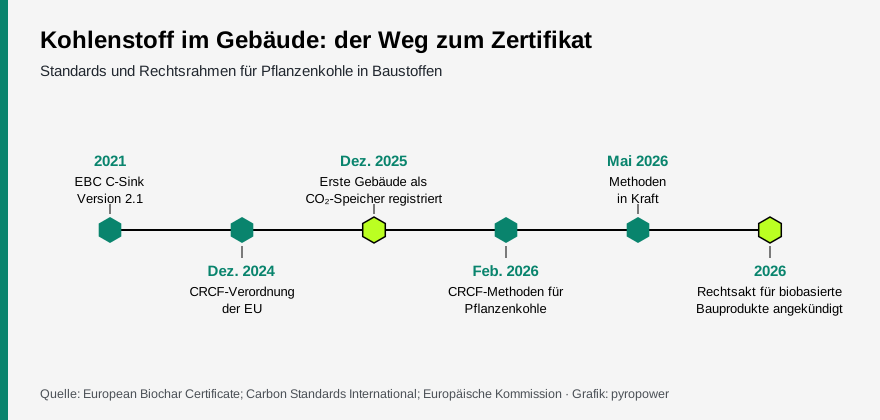
The European Biochar Certificate keeps a list of materials in which biochar counts as a long-term sink. These include concrete, cement mortar, lime mortar and gypsum, clay plaster, clay bricks and clay boards, as well as asphalt. A carbon retention of 100 percent is assumed for them. The conditions are clear: the material may not be thermally treated beyond drying, the installation site is registered, demolition must be reported and the material should be recycled back into building material or aggregate. Thermal recovery at the end of life is excluded. Emissions from transport, grinding and mixing are deducted from the bound quantity.
First certified buildings
Under the Global Construction C-Sink Standard, the first buildings in Switzerland were registered as carbon stores in December 2025, including a project in Widnau with biochar concrete in the stairwell. The carbon counts as stored from day one. If a component is reused and recertified, the status is retained.
Study in focus
The first buildings as carbon stores
Global Construction C-Sink, Carbon Standards International, December 2025
- First buildings in Switzerland entered in the CO₂ sink register.
- Including a project in Widnau with biochar concrete in the stairwell.
- The carbon counts as stored from day one.
- With reuse and recertification, the status is retained.
The European framework
With the Carbon Removals and Carbon Farming Certification Regulation, CRCF for short, the EU is creating its own framework. In February 2026, the Commission adopted the first methods for long-term carbon removals, including biochar in soil and in materials. A dedicated legal act for carbon storage in bio-based construction products has been announced for 2026. How long-term storage in building materials will be verified in detail has not yet been finally clarified.
Biochar in the environmental product declaration
In environmental product declarations according to EN 15804, biogenic carbon is reported separately. If the mass share is below 5 percent, reporting is optional. With usual dosages, the biochar can therefore remain invisible in the EPD. Anyone who wants to show the store should report it voluntarily. The distinction is important: a sink can either be sold as a certificate or claimed as a property of the product, not both. Experts also recommend reporting emissions and sink separately rather than offsetting them against each other.
A simplified calculation example
Depending on its carbon content, one tonne of biochar with a high carbon content corresponds to up to around three tonnes of CO₂ equivalent. The emissions from transport, grinding and mixing are deducted from this quantity. What remains is the creditable sink. With building materials, there is an additional question that does not arise in the same way in soil: what happens at the end of the building’s life? Under EBC, the material must be reused as building material or aggregate. If it is incinerated, the sink no longer applies.
Good to know
A sink may only be used once. Anyone selling certificates cannot additionally advertise the same carbon as a property of their product.
Tips for manufacturers
- Purchase biochar with EBC certification and traceability.
- Have the installation site registered if certificates are planned.
- Report the biogenic carbon in the EPD, even below 5 percent.
- Market the sink only once.
- Keep an eye on the announced EU legal act for construction products.
Talk to us
Would you like to use biochar in your business or your product? We advise you on quality, grain size and quantity and provide samples. Feel free to use our contact form or request biochar directly in an XXL big bag .
Frequently asked questions answered briefly
Can the sink be used both as a certificate and as a product property?
Both are possible, but not at the same time for the same carbon. Either you sell the sink as a certificate or you report it as a property of your product.
Does the installation site have to be documented?
For a long-term sink under EBC, the installation site must be registered, for example with an address or coordinates. Without registration, the sink counts as diffuse.
Is the sink lost during demolition and recycling?
Demolition must be reported. If the material continues to be used as building material or aggregate, the sink remains. Incineration ends it.
Sources
European Biochar Certificate: positive list of matrices
European Biochar Certificate: C-Sink Guidelines version 2.1
SGBA: first biogenic building in the CO₂ sink register
European Commission: first methods for long-term carbon removals (February 2026)
One Click LCA: changes to EN 15804 for EPDs
Carbone 4 (2025): Benefits of biochar in construction
We summarise the results in our own words. Figures are averages or individual results from the studies mentioned and cannot simply be transferred to every site.
Download
Brochure and data sheet Pyro-ClinX
Technical data, feedstocks, products and the course of a project at a glance (PDF).
Download brochure (PDF)

 info@pyro-power.com
 +49 355 866 870 82
 pyropower GmbH