
Funding for Pyrolysis Plants in Germany 2026: Programmes, Opportunities and Deadlines

31.10.2026
Funding for Pyrolysis Plants in Germany 2026: Programmes, Opportunities and Deadlines
There are more funding options for a pyrolysis plant in Germany than a single programme would suggest. Funding applies at several points: electricity from biomass, heat in networks, the investment itself and its financing. Which building blocks apply depends on sector, region and project. This overview shows, as of October 2026, which programmes come into question and what matters when combining them.

Lucie Töpfer
Managing Director, pyropower GmbH

Key facts
- Funding applies at several points: EEG and KWKG for electricity, BEW and KWKG for heat networks, GRW and state programmes for the investment, KfW for financing.
- Sector and region matter: industry, agriculture, municipalities and energy suppliers each have different programmes. Structurally weak regions and coal regions offer additional structural funding.
- Since 2026, the GRW offers new options for investments in your own renewable energy supply, in Brandenburg with a base funding rate of 45 %.
- Grants and development loans are applied for before the project starts. The pyropower pre-project phase includes a funding check at no extra cost.
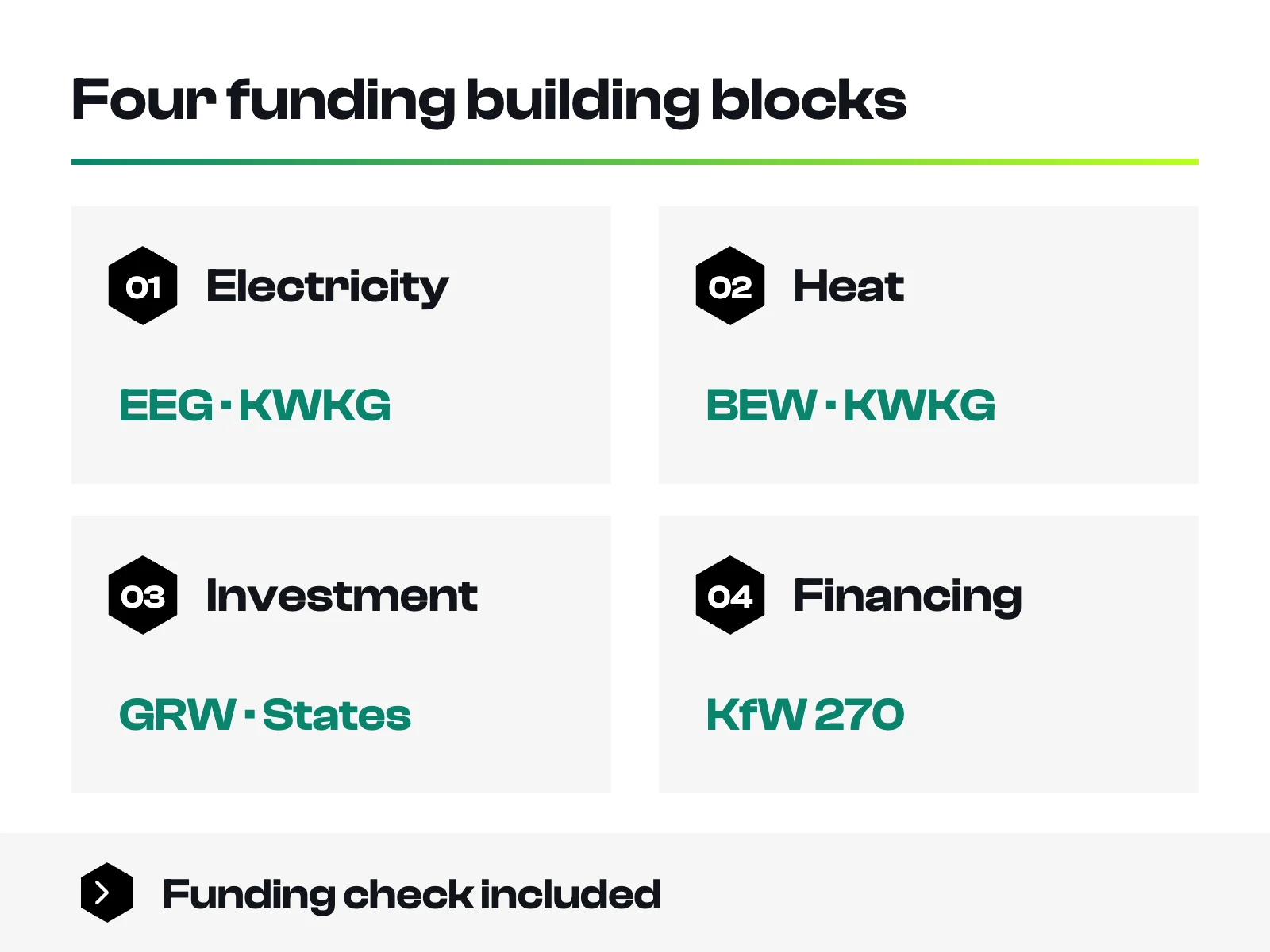
The programmes at a glance
The table sorts the main programmes by what they fund and who they are intended for.
| Programme | What is funded | For whom |
|---|---|---|
| EEG | Payment for electricity from biomass fed into the grid, up to 150 kW installed capacity without a tender | Operators feeding power into the grid |
| KWKG | Premium for electricity from high-efficiency CHP plants, including biomass, and for heat networks | Operators of CHP plants and heat networks |
| GRW | Investment grants in structurally weak regions, since 2026 also for renewable self-supply | Commercial companies in eligible regions |
| BEW | Feasibility studies and construction or conversion of heat networks, up to 40 % of eligible costs | Heat network operators such as municipal utilities |
| KfW 270 | Loan for power and CHP plants based on biomass, up to 100 % of eligible costs | Companies and farms |
| Agricultural funding | Agricultural investment support of the federal states, development loans from Rentenbank | Farms |
| Structural funding | Funds for structural change, for example in Lusatia | Depending on programme and region |
Electricity: EEG and KWKG
The Renewable Energy Sources Act (EEG) pays for electricity from solid biomass that is fed into the grid. Up to 150 kW installed capacity, a statutory value applies without a tender, and its level depends on the year of commissioning. Larger plants obtain their value in one of the Federal Network Agency tender rounds on 1 April and 1 October. With the biomass package approved by the European Commission in September 2025, revised rules have applied since the April 2026 round.
The Combined Heat and Power Act (KWKG) supports electricity from high-efficiency CHP plants and explicitly allows biomass as fuel. Approval by the Federal Office BAFA is required. The current framework applies to plants that enter continuous operation by 31 December 2026. Plants commissioned later are still covered if they are permitted under the Federal Immission Control Act or firmly ordered by the end of 2026 and enter operation within the statutory period.
Things continue after that: on 21 September 2026, the Federal Ministry for Economic Affairs presented key points for a new KWKG. Planned measures include:
- funding rates higher by half, with fewer funded full-load hours,
- a uniform premium for plants from 25 to 500 kW from 2028,
- direct marketing for new plants from 2029.
The law is to enter into force by the first quarter of 2027 at the latest.
Which route fits better depends mainly on how much electricity is used on site. Self-consumed electricity replaces grid purchases and is often worth more than electricity fed into the grid.
Investment: GRW and structural funding
For the investment itself, regional funding is of interest. The joint task for improving regional economic structures (GRW) provides investment grants to commercial companies in structurally weak regions. A new coordination framework has applied since 1 January 2026 that gives stronger support to investments in transformation. The federal states implement it in their own guidelines.
Brandenburg, for example, has funded transformation investments since August 2026 in which a company generates its energy from renewable sources mainly for its own operations. The base funding rate is 45 %, up to 55 % for medium-sized companies and up to 65 % for small companies. One condition is that no EEG payment is claimed for the project.
Coal regions such as Lusatia also have funds for structural change, for example from the EU Just Transition Fund (JTF). Which guideline takes precedence and which rate applies depends on region, company size and project.
Sector and applicant make a difference
Which programmes apply depends strongly on who operates the plant:
- Industry and commerce: GRW and state programmes for the investment, KfW 270 for financing, EEG or KWKG for electricity.
- Agriculture: Separate programmes apply here. Options include the agricultural investment support of the federal states, which usually covers self-supply plants without feed-in to the public grid, and development loans from Landwirtschaftliche Rentenbank, which has had a new programme structure since July 2026.
- Municipalities and municipal utilities: BEW and the KWKG heat network premium for heat networks, plus municipal programmes of the federal states.
- Energy suppliers and operating companies: mainly EEG and KWKG.
Company size, location and whether electricity and heat are used on site or sold also play a role. That is why a funding check for the specific project pays off.
Checklist for the turn of the year
- Secure the KWKG framework: commissioning, a permit or a firm order by the end of 2026 secures the current funding framework. Whether an order counts as firm in an individual case should be checked legally.
- Applications before contracts: for grants and development loans, signing a supply or service contract usually counts as the start of the project. Planning services usually do not.
- Use the funding check: in the pyropower pre-project phase, we check at no extra cost which programmes suit the project.
- Involve the grid operator early: connection request and metering concept need lead time and help determine the commissioning date.
Heat and financing
If heat is distributed to several buildings via a network, the Federal Funding for Efficient Heat Networks (BEW) comes into question. It funds feasibility studies as well as construction and conversion of heat networks with up to 40 % of eligible costs. The guideline sets its own requirements for the share of biomass. In addition, the KWKG pays a premium per metre of route for heat networks fed by CHP plants.
For financing, KfW offers the Renewable Energies Standard loan (270). According to its information sheet, it finances power and CHP plants based on biomass up to 100 % of eligible costs if the fuels meet the EU sustainability criteria. If the plant receives EEG or KWKG payments, the loan variant without state aid is used.
With funding, it is the combination that counts. Many projects find a suitable building block, be it for electricity, heat or the investment. That is why the funding check is a fixed part of our pre-project phase.
Lucie TöpferManaging Director, pyropower GmbH
Additional revenues alongside funding
Besides the programmes, two revenue sources contribute to financing that do not depend on public budgets: selling biochar and CO₂ removal certificates. Certificates require the biochar to be produced in line with the EBC standard, the carbon to remain bound in its application and its whereabouts to be documented. More on this on our biochar page. For the Pyro-ClinX, pyropower takes over the biochar and certificates on request.
Conclusion
As of October 2026, there is a whole range of funding building blocks for pyrolysis plants in Germany: EEG or KWKG for electricity, BEW and KWKG for heat networks, GRW and structural funding for the investment, agricultural funding for farms and KfW 270 for financing. Not every programme suits every plant; the EEW funding for process heat, for example, does not currently cover pyrolysis plants. All the more reason to look for the right combination. The pyropower pre-project phase includes a funding check at no extra cost. How funding and revenues show up in the calculation is explained in the article Economics of a pyrolysis plant, and the cost side in the article Pyrolysis plant costs.
This overview does not replace funding advice. The applicable laws, guidelines and information sheets of the funding bodies are binding.
Frequently asked questions
Is there funding for pyrolysis plants?
Yes, through several building blocks: EEG and KWKG for electricity, BEW and KWKG for heat networks, GRW and state programmes for the investment and KfW 270 for financing. Which of them fit depends on sector, region and project.
How high can an investment grant be?
That depends on programme, region and company size. In Brandenburg, the GRW base funding rate for transformation investments in renewable self-supply is 45 %, and up to 65 % for small companies.
What applies to farms?
Separate programmes apply, above all the agricultural investment support of the federal states and the development loans of Landwirtschaftliche Rentenbank. In addition, EEG and KWKG apply to electricity.
Can EEG payments and a KfW loan be combined?
Yes, with the loan variant without state aid. According to the information sheet, this also applies to plants receiving a KWKG premium.
When does the funding application have to be submitted?
For grants and development loans, before the project starts, which usually means before signing a supply or service contract. Under the KWKG, approval by BAFA is usually applied for after commissioning.
What changes with the new KWKG?
The key points of September 2026 include funding rates higher by half with fewer funded full-load hours, a uniform premium for plants from 25 to 500 kW from 2028 and direct marketing for new plants from 2029. A draft law is not yet available.
What does the funding check cost?
It is included in the pyropower pre-project phase at no extra cost. We check which programmes suit sector, region and project.
Sources
- Section 6 KWKG (German)
- Rödl & Partner: key points of the KWKG amendment, September 2026 (German)
- top agrar: biomass tender 2026 (German)
- State of Brandenburg: GRW guideline 2026 (German)
- PNO: GRW reform from 2026 (German)
- KfW: information sheet Renewable Energies Standard (270) (German)
- Förderdatenbank: Federal Funding for Efficient Heat Networks (German)
Download
Brochure and data sheet Pyro-ClinX
Technical data, feedstocks, products and project steps at a glance (PDF).
Download brochure (PDF)

 info@pyro-power.com
 +49 355 866 870 82
 pyropower GmbH