
Pyrolysis and biochar in Switzerland: legal framework, climate policy and market 2026

30.10.2026
Pyrolysis and biochar in Switzerland: legal framework, climate policy and market 2026
In short: Switzerland shaped biochar early on: the guidelines of the European Biochar Certificate (EBC) were developed in Valais in 2012. Today, the Fertiliser Ordinance governs its use in agriculture, and authorisation from the Federal Office for Agriculture is mandatory. The federal government and the cantons see biochar as one building block for negative emissions, but currently advise caution on agricultural soils. For new plants, energy therefore matters most: electricity and heat from waste wood, with biochar as an additional product.
Hardly any country has influenced the debate on biochar as much as Switzerland. The first quality standards were written here, there are field trials spanning many years and an active debate on climate targets and negative emissions. At the same time, the federal government and the cantons published a cautious assessment in 2026.
This article summarises the state of play in five areas: chronology, legal framework, climate policy, energy and market. All information is supported by sources, as of October 2026.
Sebastian Kießling
Managing Director Technology, pyropower GmbH

Key points
- The guidelines of the European Biochar Certificate were published in 2012, developed by the Ithaka Institute in Valais.
- Since 2024, the Fertiliser Ordinance has regulated biochar in line with the EU. In agriculture, authorisation from the FOAG is mandatory.
- Since March 2026, FOEN, FOAG and Cercle Sol have advised against large-scale application on agricultural soils.
- The Climate Act has applied since 2025 and sets net zero by 2050. Domestic projects can receive attestations if the carbon is stored for at least 30 years.
- Wood is Switzerland’s second most important renewable energy source, with around 1.18 million cubic metres of additional usable potential per year.
Chronology: biochar in Switzerland
The key steps from the first quality standards to current climate policy:
| Year | Event |
|---|---|
| 2012 | First guidelines of the European Biochar Certificate (EBC), developed by the Ithaka Institute in Arbaz (Valais) |
| 2013 | First conditional approval of biochar in agriculture by the FOAG |
| 2021 | IWB start producing biochar with district heating in Basel. In Zurich, the Black goes Green field trial begins. |
| 2022 | Federal Council report on CO₂ capture (CCS) and negative emission technologies (NET) |
| 2023 | Adoption of the Climate and Innovation Act (KlG) in the referendum of 18 June |
| 2024 | Revised Fertiliser Ordinance: biochar becomes component category CMC 14, aligned with the EU |
| 2025 | KlG and the revised CO₂ Act enter into force on 1 January. In December, the first buildings are registered as carbon sinks. |
| 2026 | Fact sheet by FOEN, FOAG and Cercle Sol on biochar in agriculture (March) |
| 2031 | Planned entry into force of a new CO₂ Act and a framework for CO₂ removal and storage |
Today, the EBC is run by Carbon Standards International AG in Frick (Aargau). It defines which feedstocks biochar may be made from, which limit values apply and how production and quality are documented.
Legal framework in agriculture
Since 1 January 2024, the Swiss Fertiliser Ordinance (DüV) has been aligned with EU Fertilising Products Regulation 2019/1009. Biochar belongs to component category CMC 14, i.e. materials from pyrolysis or gasification. In some respects, the Swiss requirements are stricter than those of the EU. The rules at a glance:
| Topic | Rule in Switzerland |
|---|---|
| Placing on the market | Authorisation from the Federal Office for Agriculture (FOAG) |
| Process | at least 500 °C for 10 minutes |
| Additives | max. 10 % (EU: 25 %) |
| PAH16 | max. 4 mg/kg (EU: 6 mg/kg) |
| Pollutants | limit values under the Chemical Risk Reduction Ordinance (ORRChem) |
| Permitted feedstocks | clean plant residues, untreated wood, separately collected bio-waste |
| Excluded materials | waste wood, municipal waste, sewage sludge, farmyard manure |
| Application | max. 1 t per hectare and year, max. 10 t per hectare in 20 years |
| Feed and bedding | regulated by the Animal Feed Ordinance |
| Open systems | generally not eligible for authorisation |
Role of the EBC certificate
According to the explanatory notes on the revision, the FOAG requirements, i.e. regular analyses and monitoring of the process temperature, replace the former EBC obligation. In practice, a certificate in line with the EBC standard is still used as proof. The FOAG clarifies which proof is sufficient in each case.
For a comparison with the legal situation in Germany, see our article Biochar on arable land: legal framework.
The authorities’ assessment in 2026
In March 2026, the Federal Office for the Environment (FOEN), the FOAG and Cercle Sol, the network of cantonal soil protection agencies, published the second edition of their fact sheet on biochar in agriculture. The key message: the authorities currently advise against large-scale application on agricultural soils, citing the precautionary principle.
The reasons at a glance:
- An increase in yield has not been demonstrated under Swiss conditions.
- The climate potential on arable land is considered limited. The annual decomposition of biochar in soil is estimated at less than 0.3 %, and long-term studies under Swiss conditions are lacking.
- In the Zurich field trial, earthworm biomass fell by 28 to 30 % two to three years after an application of 8 t/ha and recovered after around four years.
- Interactions with plant protection products and the effect on ammonia emissions are also still open.
Other applications
The fact sheet refers to agricultural soils. Other applications, for example in building materials, are subject to their own rules. In Switzerland, the first buildings were registered as carbon sinks under the Global Construction C-Sink Standard in December 2025. More on this in our article Carbon accounting for biochar in building materials.
Climate policy and attestations
Four laws and reports shape the framework for biochar as a climate protection measure:
| Instrument | Key point | Status |
|---|---|---|
| Climate and Innovation Act (KlG) | net zero greenhouse gas emissions by 2050 | in force since 1 January 2025 |
| Revised CO₂ Act | halving emissions by 2030 compared with 1990 | in force since 1 January 2025 |
| Federal Council report on CCS and NET | around 2050, around 12 million t CO₂ equivalent hard to avoid, of which around 5 million t to be offset via CCS and almost 7 million t via NET | May 2022 |
| Climate policy after 2030 | new CO₂ Act and framework for CO₂ removal and storage | entry into force planned for 2031 |
In the Federal Council report, biochar is one of the plant-based NETs, but makes only a small contribution in the model because of uncertainties.
Conditions for attestations
Domestic biochar projects can be approved as offset projects and receive attestations. The following applies:
- Only storage in Switzerland is eligible for attestations.
- The carbon must remain stored for at least 30 years (Art. 5 para. 2 CO₂ Ordinance).
- If the storage effect is reversed, the attestations are no longer recognised.
Some cantons call for longer periods: Basel-Landschaft argued for 100 years, and a fact sheet for the canton of Aargau only counts biochar as CO₂ removal from 100 years. For agriculture, the 2026 fact sheet notes that selling attestations alone usually does not make its use economical. Read more about certificates in our article Carbon sink certificates for biochar.
Wood energy, funding and air pollution control
After hydropower, wood is Switzerland’s second most important renewable energy source. The key figures:
| Indicator | Value |
|---|---|
| Share of final energy consumption | almost 6 % (FOEN) |
| Energy wood used in 2024 | around 5.94 million m³ (Holzenergie Schweiz) |
| Additional usable potential | around 1.18 million m³ per year (Holzenergie Schweiz) |
| of which forest wood | around 0.79 million m³ per year (Holzenergie Schweiz) |
Funding
- Electricity: The Energy Act provides for a sliding market premium or a combined investment and operating cost contribution for wood-fired power plants, administered by Pronovo. Whether a plant with pyrolysis qualifies must be checked case by case.
- Heat: The cantons have their own programmes. Aargau, for example, funds wood heating systems from 70 kW with a contribution per kilowatt of heat output, combined with requirements under QM Holzheizwerke and an air quality acceptance measurement.
Permits and air pollution control
- Commercial pyrolysis plants require a cantonal or municipal permit.
- The Ordinance on Air Pollution Control (OAPC) sets limit values for dust and carbon monoxide depending on plant type and output.
- According to the cantonal government, pure pyrolysis plants outside the building zone are not eligible for a permit in the canton of Zurich.
Market and municipal examples
There are no official statistics on pyrolysis plants and production volumes in Switzerland. Even the canton of Zurich says it has no complete overview. The available figures:
| Indicator | Value | Source |
|---|---|---|
| Share of Austria and Switzerland in European capacity, end of 2022 | 18 % of around 53,000 t | European Biochar Market Report |
| Plants in Europe, end of 2025 | 205 plants, around 361,000 t annual capacity | Biochar Europe |
| Market price for biochar in Switzerland | around CHF 1,000 per tonne | Fact sheet 2026 |
| Production costs | CHF 300 to 750 per tonne | Fact sheet 2026 |
Municipal examples
- Basel: Since 2021, IWB have produced biochar and district heating, around 550 t of biochar and around 1,500 MWh of heat in the first year.
- Basel: The city’s parks department supplies woody cuttings and uses the resulting biochar to make biochar compost.
- Zurich: Grün Stadt Zürich and FiBL are studying around 45 t of biochar on around 12 hectares over at least seven years in the Black goes Green field trial.
What it means for new projects
For operators in Switzerland, the focus is shifting: a pyrolysis project should pay for itself primarily through electricity and heat. Biochar and possible attestations are additional revenues whose level depends on the sales channel, authorisation and proof. Three points belong at the start:
- Site and permit: coordinate cantonal requirements, building zone and air pollution control early on.
- Heat offtake: a buyer with demand throughout the year, such as a heating network, process heat or drying, makes operation predictable.
- Biochar sales: FOAG authorisation is required for agriculture. Separate rules apply to building materials and technical applications.
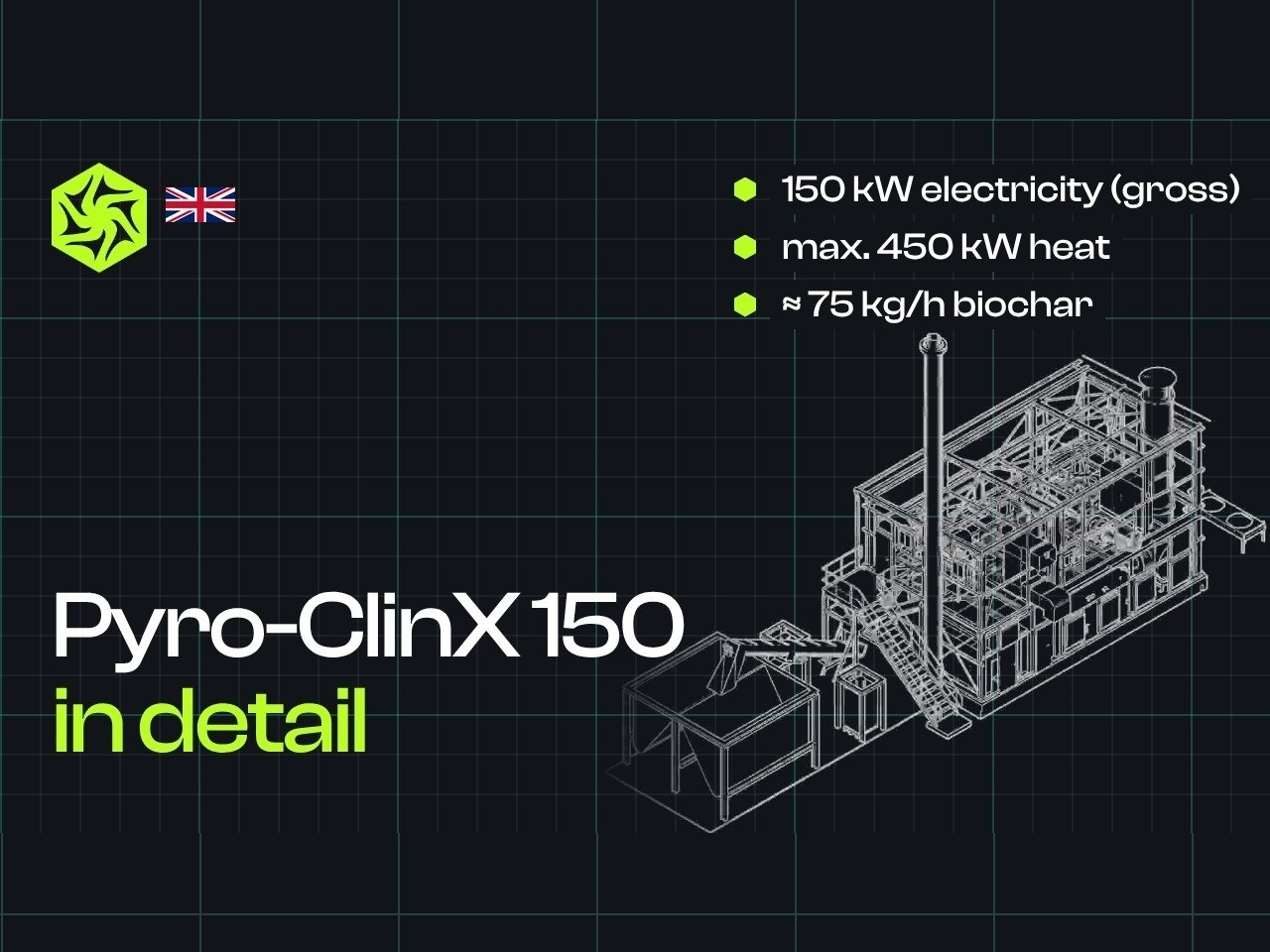
pyropower develops and supplies plants that produce electricity, heat and biochar from woody residues. The Pyro-ClinX combines pyrolysis with an externally fired micro gas turbine and supplies 150 kW of gross electrical output and up to 450 kW of heat. Together with you, we clarify in an initial assessment whether a site is suitable.
Frequently asked questions
Is biochar approved in Swiss agriculture?
Yes, with authorisation from the FOAG. Since 2024, the requirements of the Fertiliser Ordinance have applied; they are aligned with EU rules and stricter in some respects.
Does biochar need an EBC certificate in Switzerland?
Not necessarily in every case. The FOAG requires its own proof, such as regular analyses and monitoring of the process temperature. In practice, a certificate in line with the EBC standard is often used as proof. The FOAG clarifies the details in the authorisation procedure.
Can biochar projects receive CO₂ attestations?
Yes, as domestic projects under certain conditions. The carbon must remain stored for at least 30 years, and the storage effect must be proven.
Can a pyrolysis plant be built at any site?
No. Commercial plants need a cantonal or municipal permit, the Ordinance on Air Pollution Control must be complied with, and depending on the canton, the location inside or outside the building zone plays a role.
Sources
Agriculture and legal framework
- FOEN, FOAG, Cercle Sol (2026): fact sheet on biochar in Swiss agriculture, 2nd edition. ag.ch
- FOEN (2026): biochar. bafu.admin.ch
- Ithaka Journal (2012): European Biochar Certificate. ithaka-journal.net
- Ithaka Journal (2013): approval of biochar in Switzerland. ithaka-journal.net
- Hagemann, N. (2025): legal status of biochar in Switzerland, Ithaka Journal. ithaka-journal.net
- EAER (2023): explanatory notes on the revision of the Fertiliser Ordinance. fedlex.admin.ch
Climate policy
- Federal Council (2022): CO₂ capture and storage (CCS) and negative emission technologies (NET), report. admin.ch
- FOEN (2025): fact sheet on CO₂ removal and storage, legal framework. bafu.admin.ch
- FOEN (2026): climate target 2030. bafu.admin.ch
- FOEN (2025): offsetting CO₂ emissions, projects and programmes, enforcement notice UV-1315. bafu.admin.ch
- Federal Council (2025): climate policy after 2030, press release of 12 September 2025. admin.ch
- Canton of Basel-Landschaft (2024): consultation response. baselland.talus.ch
- INFRAS on behalf of the canton of Aargau (2025): fact sheet on biochar, CCS and CDR. ag.ch
Energy
- FOEN (2023): wood energy. bafu.admin.ch
- Holzenergie Schweiz (2026): annual report 2025. holzenergie.ch
- SFOE (2025): biomass funding. bfe.admin.ch
- Canton of Aargau (2026): wood heating funding programme. ag.ch
- Cantonal government of Zurich (2024): RRB No. 846/2024. zh.ch
Market and examples
- European Biochar Industry Consortium (2023): European Biochar Market Report 2022/2023. cieem.net
- Bioenergy International (2026): Biochar Europe releases fifth European biochar market report. bioenergyinternational.com
- SFOE (2023): technical article on pyrolysis and biochar. bfe.admin.ch
- Canton of Basel-Stadt (2024): reducing CO₂ with biochar and promoting tree growth. bs.ch
- FiBL and City of Zurich (2021): Black goes Green, press release. fibl.org
 info@pyro-power.com
 +49 355 866 870 82
 pyropower GmbH