
Biochar in the trough: what feeding trials show
19.10.2026
Biochar in the trough: what feeding trials show
An old home remedy in a new light
Charcoal has long been used for digestive problems in animals. Today, agriculture is above all interested in whether biochar in feed supports animal health, improves feed conversion or even reduces methane from the rumen. Research in recent years gives nuanced answers.
Key facts in brief
- Biochar is listed in the EU Catalogue of feed materials.
- A review of 112 papers sees mainly positive trends, but many results that are not significant.
- In dairy cows, trials in respiration chambers showed no effect on methane.
- In piglets, small quantities around weaning had a positive effect, large quantities a negative one.
- From 2027, the EBC feed class will be called EBC-FeedPlus.

Lucie Töpfer
Managing Director, pyropower GmbH

How biochar can work in the digestive tract
In the gut, biochar meets a mixture of feed residues, microorganisms and metabolic products. Its large surface can bind undesirable substances such as certain toxins, which are then excreted. At the same time, it offers microorganisms a surface to settle on. The hoped-for effects derive from this: more stable digestion, better feed conversion and healthier animals. The downside: biochar does not distinguish between desirable and undesirable substances. Fat-soluble vitamins can also be bound. That is why the dose matters, and why particularly strict quality requirements apply to feed-grade biochar.
What trials show
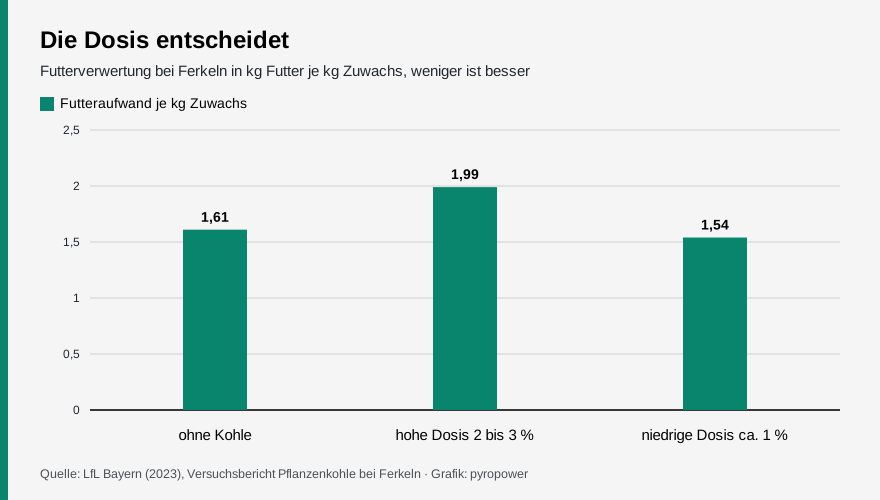
A comprehensive 2019 review by Schmidt and colleagues evaluated 112 publications. Most report positive trends in toxin binding, digestion and feed conversion, but many results were not statistically significant. Usual quantities were 100 to 400 grams per day for cattle and 0.2 to 1 percent of the ration for pigs and poultry. One note from the review: fat-soluble vitamins may be absorbed less well. The Bavarian State Research Center for Agriculture (LfL) carried out a well-documented trial with piglets. High doses of 2 to 3 percent of the ration worsened weight gain and feed conversion. Small quantities of about 1 percent in the weaning feed slightly improved feed conversion. The LfL therefore recommends only the low dose around weaning.
Methane from the rumen
Laboratory trials and a 2023 meta-analysis pointed to a reduction in methane. This was not confirmed in more recent trials with animals: at FiBL and ETH Zurich, methane in dairy cows remained unchanged with 1 percent biochar in the ration, as it did in a trial by HBLFA Raumberg-Gumpenstein with 200 grams per day. No effect was found in lambs either. We therefore do not advertise a methane reduction in the barn. A benefit with certain rations or in problem situations is not ruled out by this, but it is not proven.
Study in focus
Dairy cows in the respiration chamber
Dittmann et al., Animal Feed Science and Technology, 2024 (FiBL and ETH Zurich)
- Eight dairy cows in a crossover trial, measurement in respiration chambers.
- Biochar at 1 percent of dry matter in the ration.
- No effect on methane, milk yield, feed intake or digestibility.
- The authors do not rule out a benefit for sick animals or poor rations.
An example from poultry farming
In an organic barn trial with more than 4,000 broilers, the share of animals with footpad lesions fell from 56 to 14 percent with 1 percent biochar in the feed. Final weight was slightly higher. Feed conversion, however, was worse, which the authors attribute to feed losses. Interestingly, biochar in the bedding alone brought no improvement for the footpads in this trial.
Legal framework
Biochar is listed in the EU Catalogue of feed materials. Anyone placing it on the market as feed must be registered as a feed business operator. The European Biochar Certificate places particularly strict requirements on feed-grade biochar: only pure plant biomass, a higher pyrolysis temperature and low limits for PAHs, heavy metals and dioxins. From 2027, this class will be called EBC-FeedPlus. One advantage of feed quality: biochar approved for feed may then continue to work in bedding, manure, biogas plants and soil. This creates a cascade, which is described in the article on biochar in manure and slurry .
Practical tips
- Dose low, about 0.5 to 1 percent of the ration, and use it specifically in problem phases.
- Only use feed-grade biochar from registered manufacturers.
- Observe the effect on your own farm, ideally compared with a control group.
- Coordinate with your vet and feed adviser.
Talk to us
Would you like to use biochar in your business or your product? We advise you on quality, grain size and quantity and provide samples. Feel free to use our contact form or request biochar directly in an XXL big bag .
Frequently asked questions answered briefly
Is feed-grade biochar suitable for cattle, pigs and poultry?
There are trials for all three species. The usual quantities differ: for cattle usually 100 to 400 grams per day, for pigs and poultry 0.2 to 1 percent of the ration.
Should biochar be fed continuously?
Targeted use in critical phases, for example around piglet weaning, is best documented. Continuous feeding without a specific reason is not necessary.
May an organic farm feed biochar?
Whether and how biochar may be fed in organic farming is governed by the requirements of the EU organic regulation and the farming associations. Clarify this in advance with your inspection body.
Sources
Schmidt et al. (2019): Biochar in animal feeding, review. PeerJ
Dittmann et al. (2024): Biochar in dairy cows, FiBL and ETH. Anim. Feed Sci. Technol. 318
Terler et al. (2023): Biochar in dairy cows, HBLFA Raumberg-Gumpenstein. Czech J. Anim. Sci. 68
LfL Bavaria (2023): Trial report on biochar in piglets
Albiker et al. (2019): Biochar in organic broilers
European Biochar Certificate, Guidelines Version 10.5 (2025)
We summarise the results in our own words. Figures are averages or individual results from the studies mentioned and cannot simply be transferred to every site.
Download
Brochure and data sheet Pyro-ClinX
Technical data, feedstocks, products and the course of a project at a glance (PDF).
Download brochure (PDF)
 info@pyro-power.com
 +49 355 866 870 82
 pyropower GmbH