
Concrete as a carbon store: biochar in building materials
12.10.2026
Concrete as a carbon store: biochar in building materials
Concrete as a carbon store
Concrete is the most widely used building material in the world and, through cement, causes a large share of the emissions in construction. Biochar offers an approach to turn concrete into a carbon store at the same time. This raises practical questions: how much biochar can a recipe take, what happens to strength and how robust is the balance?
Key facts in brief
- With less than 2.5 percent biochar relative to the binder, compressive strength rose by about 7 percent on average.
- Higher dosages usually have a negative effect.
- Finely ground biochar from pyrolysis above 450 °C shows the best results.
- Biochar absorbs water. The recipe has to take this into account.
- There are pilot projects in Switzerland, Norway, the United Kingdom and Germany.

Lucie Töpfer
Managing Director, pyropower GmbH

Why biochar fits into concrete
Concrete consists of cement, water and aggregate. Biochar can take on two roles: finely ground, it replaces a small part of the cement or acts as a filler between the cement grains. As granules or pellets, it replaces part of the aggregate. In both cases, its carbon remains enclosed in the component. The porous structure of biochar has two sides. It absorbs water, which makes processing more difficult. Pre-saturated, however, it can serve as a small water reservoir that keeps the concrete moist from the inside while it hardens. Experts call this internal curing.
What research says about strength
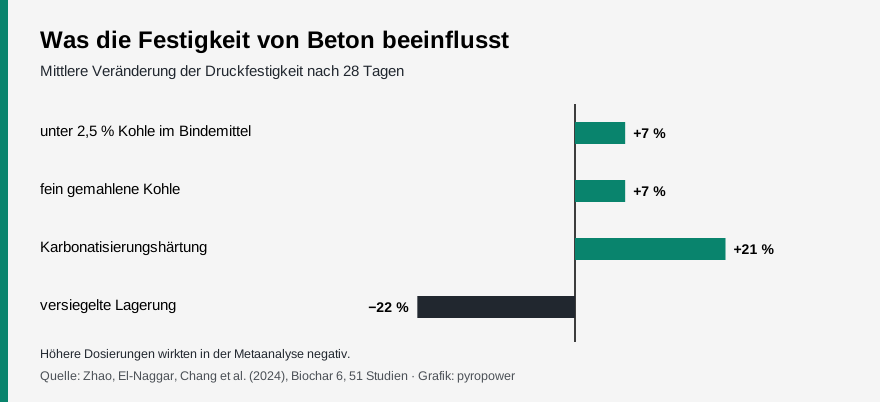
A 2024 meta-analysis evaluated 51 studies with more than 600 data pairs. On average, compressive strength after 7 and 28 days did not decrease. Below 2.5 percent biochar relative to the binder, it rose by about 6 to 7 percent. Higher shares had a negative effect. Wood-based biochar from pyrolysis above 450 °C performed best, finely ground to roughly the grain size of cement. A trial with 16 different biochars at 10 percent cement replacement showed how much the biochar itself matters: strength was comparable or better with all of them, but all biochars increased the water demand. A 2025 review names 2 to 5 percent relative to the cement as the typical range.
Water as the key
Biochar soaks up water. This impairs workability, but can also be put to use: pre-saturated biochar releases water slowly while the concrete hardens. In a 2024 trial, this reduced the shrinkage of the hardened cement paste by 82 percent and improved self-healing after cracking. In the same trial, however, strength after 28 days decreased. The recipe is therefore always a trade-off.
Pellets instead of loose biochar
Empa in Switzerland has developed a different route: biochar is formed with cement into pellets of 4 to 32 millimetres that replace part of the aggregate. This avoids problems of loose biochar such as water absorption and dust. According to Empa’s calculations, normal concrete with 20 percent by volume of such pellets binds as much CO₂ as is produced during its manufacture. Lightweight concrete with a higher share can bind even more.
Study in focus
Pellets made of biochar and cement
Wyrzykowski, Toropovs, Winnefeld, Lura, Journal of Cleaner Production, 2023 (Empa)
- Biochar is formed with cement into pellets of 4 to 32 millimetres.
- The pellets replace part of the aggregate.
- With 20 percent by volume of pellets, normal concrete binds as much CO₂ as is produced during its manufacture, according to the calculation.
- Advantage: problems of loose biochar such as water absorption and dust no longer arise.
Projects in Europe
- Switzerland: In Empa’s NEST research building, concrete and insulation with biochar are being tested. In Widnau, the first buildings were awarded a carbon storage certificate in 2025.
- Norway: The architecture firm Snøhetta has developed a concrete with biochar together with partners from the construction industry. The first building was completed in 2023.
- United Kingdom: Trial pours with biochar have been taking place in London since 2025.
- Germany: In Stuttgart, the city, a materials testing institute and concrete manufacturers are working on biochar concrete. According to a report from March 2026, the work is still at an early stage.
Important for context: there is not yet a dedicated standard for biochar as a concrete additive. Critical studies also point out that high shares of biochar can require more binder. The balance must therefore always be calculated on a net basis.
Tips for manufacturers
- Start with 2 to 5 percent relative to the cement and use finely ground biochar.
- Plan for water absorption, through pre-saturation or superplasticisers.
- Make sure the quality is consistent and specified, for example according to EBC.
- Report the climate effect on a net basis, including transport and grinding.
Talk to us
Would you like to use biochar in your business or your product? We advise you on quality, grain size and quantity and provide samples. Feel free to use our contact form or request biochar directly in an XXL big bag .
Frequently asked questions answered briefly
Is concrete with biochar approved for building construction?
There is not yet a dedicated standard for biochar as a concrete additive. Load-bearing components therefore require testing on a case-by-case basis, for example via a general building authority approval or an approval in individual cases. In non-load-bearing components such as paving stones, precast elements for landscaping or levelling layers, getting started is much easier.
Does the reinforcement suffer from biochar in concrete?
Initial investigations show no notable disadvantages with moderate additions. However, long-term data on corrosion protection of the reinforcement and frost resistance are still rare. For reinforced components, we therefore recommend examining carbonation and freeze-thaw behaviour as part of the initial testing.
Can the stored quantity per cubic metre be quantified?
The quantity depends heavily on the recipe and the share of biochar. With small additions it is low, with pellets as aggregate considerably higher. Reliable values only emerge from a balance for the specific product.
Sources
Zhao, El-Naggar, Chang et al. (2024): Biochar in cementitious materials, meta-analysis. Biochar 6
Hylton, Tunstall et al. (2024): 16 biochars in cement. Biochar 6
Vafaei, Ghahremaninezhad (2024): Internal curing with biochar. ACS Sustainable Chem. Eng.
Empa (2023): Concrete with biochar pellets, press release
Carbone 4 (2025): Benefits of biochar in construction
We summarise the results in our own words. Figures are averages or individual results from the studies mentioned and cannot simply be transferred to every site.
Download
Brochure and data sheet Pyro-ClinX
Technical data, feedstocks, products and the course of a project at a glance (PDF).
Download brochure (PDF)

 info@pyro-power.com
 +49 355 866 870 82
 pyropower GmbH