
Binding contaminants, filtering odours: biochar in environmental technology
05.08.2026
Binding contaminants, filtering odours: biochar in environmental technology
Immobilising instead of excavating
Contaminated soils are often excavated and landfilled. This is expensive and shifts the problem elsewhere. For certain cases, biochar offers a different route: it can bind pollutants in the soil so that they are less mobile and less taken up by plants and soil organisms. It can also retain odours in exhaust air. We show what is documented and where the limits lie.
Key facts in brief
- In slightly contaminated soils, dissolved PAHs fell by 85 to 97 percent with 3 to 6 percent biochar.
- In a meta-analysis, available cadmium fell by around a third, and by around two thirds with modified biochar.
- At a contaminated site in Austria, immobilisation cost around a third of excavation and landfill.
- Arsenic and antimony are not bound and can become more mobile.
- Immobilisation is not removal and requires a permit on a case-by-case basis.
Sebastian Kießling
Managing Director Technology, pyropower GmbH

Immobilising instead of removing
In conventional remediation, contaminated soil is excavated, transported away and landfilled. With immobilisation, the soil stays on site. An additive binds the pollutants so that they migrate less with seepage water and are taken up less by plants and soil organisms. Biochar is particularly suitable for organic pollutants such as PAHs and for heavy metals present as positively charged ions. The difference is important: the pollutants have not disappeared afterwards. They are immobilised. Preliminary trials, a permit and long-term monitoring are therefore always part of it.
Binding pollutants in the soil
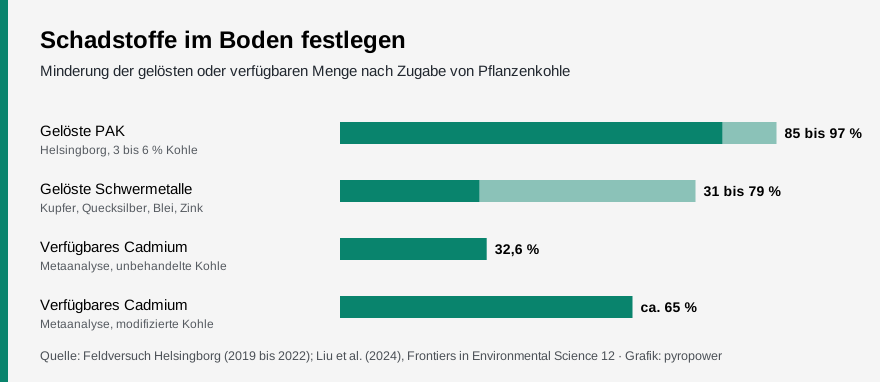
In Helsingborg in Sweden, slightly contaminated soils were treated with biochar from 2019 to 2022. With 3 to 6 percent biochar, dissolved PAHs fell by 85 to 97 percent and dissolved heavy metals such as copper, mercury, lead and zinc by 31 to 79 percent. Earthworms and grass took up fewer pollutants. 3 percent worked better than 6 percent. A 2024 meta-analysis of 58 studies found a reduction in the available quantity of cadmium of around 33 percent with untreated biochar and around 65 percent with modified biochar. 2 to 3 percent biochar in the soil is considered favourable.
A practical example from Austria
In the Austrian project KOKOSAN II, a guidance document for remediation with biochar was developed. For PAHs and several heavy metals, it recommends 0.5 to 5 percent biochar. At a former shooting range, immobilisation cost about a third of excavation and landfill. The guidance also names clear limits: the method is suitable for the unsaturated soil zone down to about one metre and not for heavily contaminated spots. Preliminary trials on site are mandatory, and permits are granted on a case-by-case basis. The same applies in Germany under soil protection law.
The limits
Immobilisation is not removal. The pollutants remain in the soil and must be monitored in the long term. Anionic substances such as arsenic, chromium, molybdenum or antimony are not bound by biochar and can even become more mobile. In Helsingborg, nitrogen availability also decreased, and plants grew less well.
Study in focus
A shooting range in Austria
KOKOSAN II project, guidance document by Umweltförderung Österreich
- Recommended quantities: 0.5 to 5 percent biochar depending on the pollutant.
- A modified biochar is required for arsenic.
- Costs: about a third of excavation and landfill.
- Limits: only the unsaturated soil zone down to about one metre, no heavily contaminated spots.
Odours in exhaust air
In a pilot plant of the US Department of Agriculture for the exhaust air of a pig barn, 14 of 15 odorous substances fell below the detection limit. Humid air considerably improved the absorption of hydrogen sulphide. However, the trial only ran for three weeks; service life and pressure loss are still open. In composting, biochar reduces emissions right at the source: meta-analyses show around a third less ammonia on average. For exhaust air filters: test biochar as part of the filter material, ideally with humidity control.
Practical tips
- For slightly contaminated soils with PAHs and cationic heavy metals, immobilisation with 2 to 5 percent biochar can be an alternative to landfill.
- Plan preliminary trials and elution tests on site.
- For arsenic or antimony, consider other methods.
- Test biochar in exhaust air filters with humidity control.
- Plan the recovery of the spent biochar from the start.
Talk to us
Would you like to use biochar in your business or your product? We advise you on quality, grain size and quantity and provide samples. Feel free to use our contact form or request biochar directly in an XXL big bag .
Frequently asked questions answered briefly
Does biochar bind all pollutants in the soil?
The effect is well documented for PAHs and for heavy metals such as cadmium, lead, copper and zinc. Arsenic and antimony are not bound by normal biochar.
Does remediation with biochar require a permit?
Yes. In Germany, permits are granted on a case-by-case basis under soil protection law, in consultation with the responsible soil protection authority. The basis is preliminary trials with the contaminated soil and elution tests that show how much the mobility of the pollutants is reduced.
Is there a recommended quantity in the soil?
Depending on the pollutant and soil, 0.5 to 5 percent is recommended. More is not automatically better: in Helsingborg, 3 percent worked better than 6 percent. The right quantity results from preliminary trials with the respective soil.
Sources
KOKOSAN II: guidance on remediation with biochar (Umweltförderung Österreich)
Landén et al.: Treatment of low-contaminated soil with biochar, Helsingborg (USBI 2024)
Liu et al. (2024): Biochar and cadmium, meta-analysis. Frontiers in Environmental Science 12
Ro et al. (2021): Biochar filter for barn exhaust air, USDA-ARS. Agronomy 11
Xu, Xiong (2025): Biochar in composting, meta-analysis. Nitrogen Cycling 1
We summarise the results in our own words. Figures are averages or individual results from the studies mentioned and cannot simply be transferred to every site.
Download
Brochure and data sheet Pyro-ClinX
Technical data, feedstocks, products and the course of a project at a glance (PDF).
Download brochure (PDF)
 info@pyro-power.com
 +49 355 866 870 82
 pyropower GmbH