
A stable digester: biochar in the biogas plant
08.09.2026
A stable digester: biochar in the biogas plant
An additive with expectations
Biochar is often recommended to biogas plants as an additive: for more methane, a more stable process and less hydrogen sulphide. Research shows a mixed picture. In the laboratory the effects are often clear, in practice smaller. We have compiled where its use can pay off.
Key facts in brief
- A meta-analysis of 76 studies found a clear increase in methane yield in the laboratory.
- At usual dosages and in normal operation, trials often showed no effect.
- Biochar is most useful with nitrogen-rich substrates and process problems.
- It works against hydrogen sulphide, but requires large quantities to do so.
- The biochar ends up in the digestate and thus on the field.

Lucie Töpfer
Managing Director, pyropower GmbH

What happens in a digester
In a biogas plant, microorganisms break down organic material in several stages. At the end, specialised methanogens form the biogas. These microorganisms are sensitive: too much ammonia, too many fatty acids or overloading of the digester slow them down. Gas production then falls, and in the worst case the process collapses. Biochar can help here in three ways: it binds ammonium, it offers the microorganisms a surface to settle on and it can facilitate the exchange of electrons between different microorganisms. How strong these effects are depends on the biochar, the dose and the condition of the digester.
What laboratory trials show
A 2022 meta-analysis evaluated 76 studies with more than 400 test conditions. On average, biochar increased methane yield and production rate and shortened the start-up phase. Dosages below 5 grams per litre worked best. Ash-rich biochars performed better than wood-based biochars. However, the results varied widely. The same study also looked at economic viability: in almost half of the cases, the biochar would not have paid off at usual market prices.
What field trials show
A 2023 trial by the University of Kassel found no effect at realistic dosages and normal loading. Only under severe overloading did methane rise slightly, without statistical confirmation. A project funded by the DBU also found no significant improvement at quantities common in practice, but no disadvantages either. In a field trial at seven plants by TU Dresden, acid levels in the digester fell with the same gas production, and microbial diversity increased. No reliable figures were published on this.
Study in focus
Realistic doses in the test
Hu, Stenchly, Gwenzi, Wachendorf, Kaetzl, University of Kassel, Frontiers in Energy Research, 2023
- Biochar at 10 to 25 percent of the organic dry matter.
- No effect on methane formation under normal loading.
- Slightly more methane under severe overloading, not statistically confirmed.
- Authors’ conclusion: effects mainly appear with inhibition and high doses.
Stability with difficult substrates
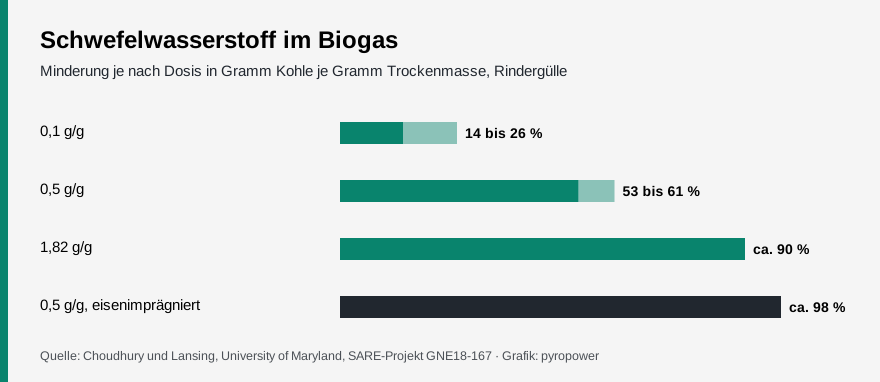
The effects are clearer when the process is under pressure. Nitrogen-rich substrates such as poultry manure lead to a lot of ammonia, which inhibits the methanogens. Biochar can bind ammonium and thus relieve the process. A 2023 review cites individual studies with considerably lower ammonium levels and fewer fatty acids. However, excessive dosages can themselves be inhibiting. Against hydrogen sulphide, a trial by the University of Maryland with cattle slurry showed reductions of 14 to 26 percent with small quantities and around 90 percent with very large quantities. An external filter with biochar was more effective than adding it directly to the digester.
The route into the digestate
Biochar does not stay in the plant. It ends up in the digestate and goes onto the field with it. Fertiliser law therefore also plays a role: in Germany, biochar from chemically untreated wood is approved. Woody residues as starting material are an advantage here. On the field, the biochar can then continue to work as a carbon store.
Tips for operators
- See biochar as a stabiliser for problem substrates, not as a general yield booster.
- Test in a long-term trial with a reference digester and also measure FOS/TAC, ammonium and hydrogen sulphide.
- Consider an external filter against hydrogen sulphide.
- Clarify admissibility in the digestate in advance.
Talk to us
Would you like to use biochar in your business or your product? We advise you on quality, grain size and quantity and provide samples. Feel free to use our contact form or request biochar directly in an XXL big bag .
Frequently asked questions answered briefly
Is there an optimal dosage in the digester?
In laboratory trials, dosages below 5 grams per litre of digestion substrate worked best. Larger quantities usually brought no additional benefit. In practice, a long-term trial over several weeks with a reference digester is recommended to find the right quantity for the substrate and plant.
Does ash-rich biochar work better than wood-based biochar?
In the meta-analysis, ash-rich biochars had a stronger effect than wood-based biochars, probably because of their buffering minerals. On the other hand, biochar from chemically untreated wood is simpler under fertiliser law in the digestate, because it is already listed in the Fertiliser Ordinance.
Are there parameters that belong in every trial?
Useful parameters are gas quantity and methane content, FOS/TAC, ammonium and hydrogen sulphide. This makes it possible to distinguish the effect from random fluctuations.
Sources
Hu, Stenchly, Gwenzi, Wachendorf, Kaetzl (2023): University of Kassel. Frontiers in Energy Research
DBU final report AZ 34932 (2021): Biochar in biogas plants
top agrar (2021): Field trial in biogas plants
Valentin et al. (2023): Review. Biotechnology for Biofuels and Bioproducts 16
Choudhury, Lansing: Biochar against H₂S, SARE project GNE18-167
We summarise the results in our own words. Figures are averages or individual results from the studies mentioned and cannot simply be transferred to every site.
Download
Brochure and data sheet Pyro-ClinX
Technical data, feedstocks, products and the course of a project at a glance (PDF).
Download brochure (PDF)
 info@pyro-power.com
 +49 355 866 870 82
 pyropower GmbH