
The fourth treatment stage: biochar against micropollutants
05.10.2026
The fourth treatment stage: biochar against micropollutants
New obligations for wastewater treatment plants
Pharmaceutical residues, industrial chemicals and cosmetic residues often pass through today’s treatment plants untreated. The new EU Urban Wastewater Treatment Directive changes this: large treatment plants will gradually have to introduce a fourth treatment stage for micropollutants. A common technology for this is activated carbon. Can biochar from regional biomass take on this task?
Key facts in brief
- The new directive has applied since January 2025 and must be transposed into national law by July 2027.
- Treatment plants from 150,000 population equivalents must have a complete fourth treatment stage by 2045.
- In a pilot plant, activated biochar removed 91 percent of 12 micropollutants on average.
- Non-activated biochar is usually not sufficient for micropollutants.
- Regional production next to the treatment plant can reduce transport and import dependency.
Lucie Töpfer
Managing Director, pyropower GmbH

What micropollutants are and why they cause problems
Micropollutants are substances that occur in very small quantities in wastewater: residues of pharmaceuticals such as painkillers or blood pressure medication, industrial chemicals and cosmetic ingredients. Conventional treatment plants only partially break down many of them. In rivers and lakes, they can affect fish and other organisms even at low concentrations. A fourth treatment stage is intended to change this. Ozonation and activated carbon are common. Activated carbon acts like a sponge for dissolved substances: its extremely fine pores hold the molecules in place. Activated carbon made from biochar can also take on this task if it is produced and activated correctly.
The new Urban Wastewater Treatment Directive
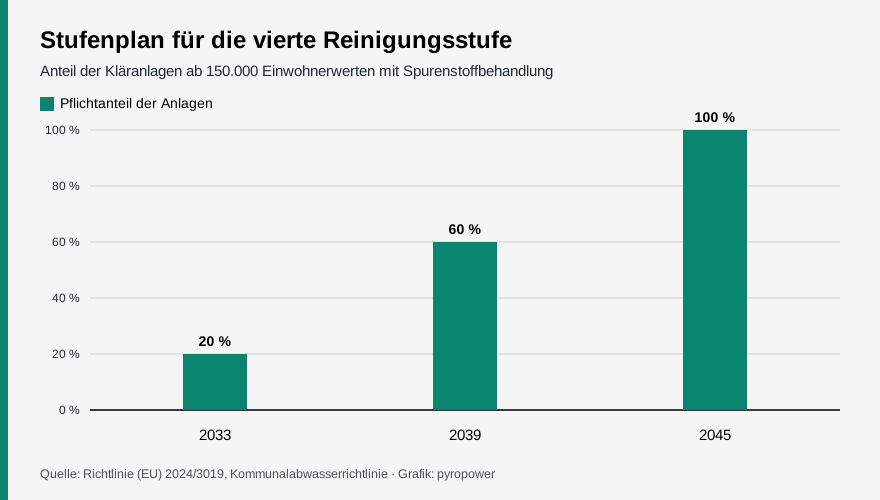
The revised EU Urban Wastewater Treatment Directive has been in force since 1 January 2025. Member states must transpose it by 31 July 2027. For treatment plants from 150,000 population equivalents, a fourth treatment stage becomes mandatory: for 20 percent of plants by 2033, for 60 percent by 2039 and for all by 2045. In risk areas, this already applies from 10,000 population equivalents. Manufacturers of pharmaceuticals and cosmetics are to bear at least 80 percent of the costs. In addition, treatment plants are to operate energy-neutrally by 2045.
What pilot plants show
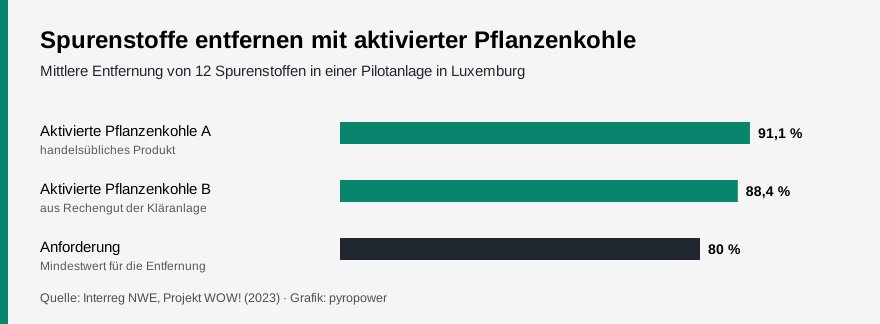
In the European project WOW!, activated biochar in a planted soil filter was tested as post-treatment at a wastewater treatment plant in Luxembourg. Across 12 micropollutants, it removed 88 to 91 percent on average, and diclofenac completely. This met the requirements in Luxembourg. In the CoAct project at Lake Constance, activated carbon was produced from regional residual biomass such as tree cuttings and landscape maintenance material. In a full-scale test, it achieved the 80 percent micropollutant removal recommended in Baden-Württemberg. The carbon footprint was better than with fossil activated carbon for all biomass types tested. Economically, however, regional biochar cannot yet compete with globally scaled activated carbon.
Activation makes the difference
Trials at OST in Switzerland show the difference clearly: non-activated biochar made from garden and park cuttings removed only a small part of the organic micropollutants. Activated biochar was considerably better, but did not quite reach commercial activated carbon. For micropollutants, activation, for example with steam, is therefore decisive. Life cycle assessments show that biochar requires considerably less energy to produce than fossil activated carbon. How good the balance is in the end, however, depends on the absorption capacity: if much more biochar has to be used, the advantage shrinks.
Study in focus
Activated carbon from the Lake Constance region
CoAct project, Bodensee-Stiftung and partners
- Starting material: regional residual biomass such as tree cuttings, landscape maintenance material and pomace.
- Production by pyrolysis and activation.
- Full-scale test at a treatment plant: more than 80 percent micropollutant removal.
- Open point: not yet economically on a par with globally traded activated carbon.
Rainwater and simple filters
For rainwater filters, non-activated biochar can also be useful. In a two-year field study, a filter with wood-based biochar retained more zinc and inorganic nitrogen than sand. There was no advantage for organic carbon and germs. The European Biochar Certificate covers such applications in the EBC-Urban class.
Tips for operators
- For micropollutants, use activated biochar and test it against commercial activated carbon in a pilot trial.
- Use the indicator substances of the directive as the benchmark.
- Consider regional production. A pyrolysis plant at the treatment plant also supplies power and heat.
- Plan the disposal of the loaded biochar from the start.
Talk to us
Would you like to use biochar in your business or your product? We advise you on quality, grain size and quantity and provide samples. Feel free to use our contact form or request biochar directly in an XXL big bag .
Frequently asked questions answered briefly
Is non-activated biochar sufficient against micropollutants?
For micropollutants, non-activated biochar is usually not sufficient. However, it can be useful for rainwater filters, planted soil filters and as a pre-treatment stage.
Can spent biochar be recovered?
Depending on its load, spent activated carbon is disposed of or recovered thermally. With regional production, take-back can also be organised regionally.
Do municipalities bear the costs of the fourth treatment stage alone?
Under the new directive, manufacturers of pharmaceuticals and cosmetics are to bear at least 80 percent of the costs of the fourth treatment stage. How this is implemented will be governed by national law by 2027.
Sources
Taylor Wessing (2025): The EU Urban Wastewater Treatment Directive
Directive (EU) 2024/3019 (EUR-Lex)
Interreg NWE, WOW! project (2023): pilot plant for micropollutant removal
Bodensee-Stiftung: CoAct project, summary of the final report
OST Eastern Switzerland University of Applied Sciences (2021): Biochar for micropollutant removal
Ulrich et al. (2024): Rainwater filters with biochar. Environ. Sci.: Water Res. Technol. 10
We summarise the results in our own words. Figures are averages or individual results from the studies mentioned and cannot simply be transferred to every site.
Download
Brochure and data sheet Pyro-ClinX
Technical data, feedstocks, products and the course of a project at a glance (PDF).
Download brochure (PDF)
 info@pyro-power.com
 +49 355 866 870 82
 pyropower GmbH