
From barn to field: biochar in farm manure
20.08.2026
From barn to field: biochar in farm manure
Where biochar makes the biggest difference
On the way from barn to field, a lot of nitrogen and climate-relevant gases are lost from farm manure. Biochar can reduce these losses, but not equally everywhere. Research shows a clear difference between solid manure and compost on the one hand and liquid slurry on the other.
Key facts in brief
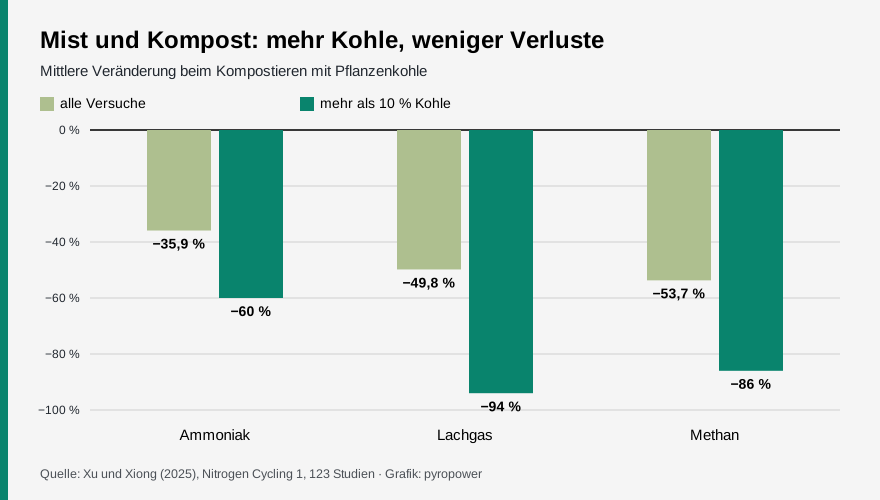
- When composting manure, methane, nitrous oxide and ammonia fall by 36 to 54 percent on average.
- The reductions were greatest from a biochar share of 10 percent.
- In cattle slurry, Bavarian trials showed no advantage, and on the field even higher ammonia losses.
- The biochar binds nitrate and brings it onto the field charged.
- The prerequisite for the feed, barn, manure, field cascade is feed quality according to EBC.

Lucie Töpfer
Managing Director, pyropower GmbH

Where losses occur in farm manure
Microbial processes are constantly at work in manure and slurry. They produce ammonia, nitrous oxide and methane. With each gas, nitrogen or carbon is lost that should actually work as fertiliser on the field. Losses are greatest during storage, composting and application. Biochar can influence these processes because it binds moisture and ammonium, improves aeration in the manure and provides a habitat for microorganisms. Whether this works depends strongly on whether the fertiliser is solid or liquid.
Solid manure and compost: well documented
A 2025 meta-analysis of 123 studies with almost 1,200 observations shows on average 54 percent less methane, 50 percent less nitrous oxide and 36 percent less ammonia for composting with biochar. With more than 10 percent biochar, the reductions were considerably greater still. With very small shares below 5 percent, on the other hand, nitrous oxide increased. As favourable conditions, the authors name 10 to 20 percent biochar in the dry matter, a C/N ratio of 20 to 30, a moisture content of 55 to 65 percent and a slightly alkaline pH. A second meta-analysis of 125 studies arrives at very similar values.
Liquid slurry: little effect
For liquid slurry, the picture is different. A Belgian trial found 12 percent less ammonia in the first week with 10 grams of biochar per litre of cattle slurry. In Bavarian projects by the LfL and TU Munich with 2.75 percent biochar in cattle slurry, on the other hand, ammonia losses in storage rose slightly because no floating crust formed. After application, they were even significantly higher because the slurry was more viscous and infiltrated less well. In liquid slurry alone, biochar is therefore not an effective means against ammonia. It can only make sense in combination with other measures, such as acidification.
Study in focus
Biochar in cattle slurry
EmiAdditiv II and TerraBayt projects, LfL Bavaria and TU Munich, 2025
- 2.75 percent biochar in cattle slurry.
- Slightly higher ammonia losses in storage because no floating crust formed.
- Significantly higher losses after application because the slurry was more viscous.
- Costs of about €7.50 to €10 per cubic metre at 1 percent biochar.
The cycle from barn to field
The strength of biochar lies in the cascade. Via feed or bedding, it gets into the manure. During composting, it absorbs nutrients and reduces gas losses. With the compost, it goes onto the field charged, where it stays in the soil for the long term. For the biochar to be allowed to pass through all stages, it has to be suitable for the first one. Under the rules of the European Biochar Certificate, farm manure from feeding, bedding or slurry treatment with feed-grade biochar may be used as a soil improver, in compost, in biogas plants and for fertiliser production.
Solid or liquid: the comparison
| Solid manure and compost | Liquid slurry | |
|---|---|---|
| Evidence | Two meta-analyses with more than 120 studies | Individual trials with mixed results |
| Effect | Considerably less ammonia, nitrous oxide and methane | Weak, in some cases higher losses |
| Recommendation | 10 to 20 percent biochar in the mix | Only in combination with other measures |
Practical tips
- Solid manure and compost with 10 to 20 percent biochar offer the greatest leverage.
- For liquid slurry, calculate costs and benefits realistically. Bavarian trials cite about €7.50 to €10 per cubic metre at 1 percent biochar.
- For the cascade, choose feed quality according to EBC.
- Document delivery and use if the carbon storage is to be certified later.
Talk to us
Would you like to use biochar in your business or your product? We advise you on quality, grain size and quantity and provide samples. Feel free to use our contact form or request biochar directly in an XXL big bag .
Frequently asked questions answered briefly
Is biochar worthwhile in the slurry pit?
In liquid slurry alone, biochar showed hardly any advantages in trials, and in some cases even disadvantages during application. Use in solid manure and compost makes more sense.
Does biochar pay off in manure management?
For liquid slurry, Bavarian trials cite about €7.50 to €10 per cubic metre. In compost, the biochar is spread over less mass and works considerably more strongly. There, the ratio is more favourable.
Can the farm generate certificates from the cycle?
If the biochar ends up in the soil in a documented way, the carbon storage can be certified. Delivery, use on the farm and application areas count for this.
Sources
Xu, Xiong (2025): Biochar in composting, meta-analysis. Nitrogen Cycling 1
Zou et al. (2025): Biochar in compost, meta-analysis. Biochar X 1
Viaene et al. (2023): Additives in cattle slurry. Waste Management 167
top agrar (2025): Can biochar reduce slurry emissions? Projects by LfL and TU Munich
European Biochar Certificate, Guidelines Version 10.5 (2025)
We summarise the results in our own words. Figures are averages or individual results from the studies mentioned and cannot simply be transferred to every site.
Download
Brochure and data sheet Pyro-ClinX
Technical data, feedstocks, products and the course of a project at a glance (PDF).
Download brochure (PDF)
 info@pyro-power.com
 +49 355 866 870 82
 pyropower GmbH