
A good indoor climate from the wall: biochar in plaster
15.09.2026
A good indoor climate from the wall: biochar in plaster
An old building material, newly mixed
Clay and lime are among the oldest building materials. They are considered vapour-permeable and pleasant for the indoor climate. Biochar fits well into this picture: its pore network can absorb moisture and release it again, and it brings carbon into the wall for the long term. Research and practice show what is documented today.
Key facts in brief
- In clay, high biochar shares of 20 to 50 percent are technically possible.
- Clay and biochar composites achieve thermal conductivities of 0.06 to 0.18 W/(m·K).
- In natural hydraulic lime, 2 percent finely ground biochar increased strength.
- Moisture regulation is plausible, but so far mainly documented by practical reports.
- For indoor use, what counts is a biochar with contaminant analyses.

Lucie Töpfer
Managing Director, pyropower GmbH

Clay, lime and biochar: why they fit together
Clay and lime plasters are vapour-permeable. They absorb moisture from the room air and release it again. Biochar enhances this property because its pore network can itself store water. At the same time, it is light and lowers the thermal conductivity of the material. Unlike concrete, a plaster does not have to carry large loads. Much higher biochar shares are therefore possible here, in clay up to half of the mix. This makes plasters a good starting point for manufacturers and tradespeople who want to work with biochar.
Clay with biochar
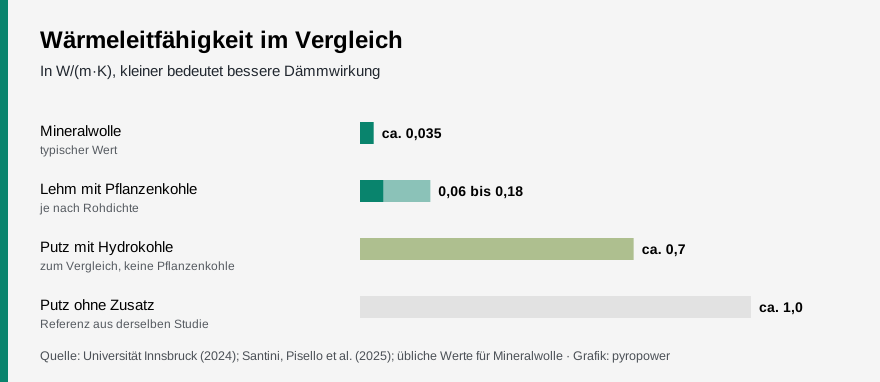
At the University of Innsbruck, clay and biochar composites for interior insulation were investigated. Depending on the bulk density, the dry thermal conductivity was between 0.06 and 0.18 W/(m·K). It increased with rising temperature and moisture. For comparison: mineral wool is around 0.035. Clay with biochar therefore does not replace a high-performance insulation material, but can make a contribution in interior insulation and as plaster. In an Austrian research project, a clay construction company and the University of Innsbruck are developing plasters, blocks and boards made of clay and biochar. The goal is moisture buffering and interior insulation in one material.
Lime with biochar
A 2026 study investigated natural hydraulic lime with finely ground biochar. With 2 percent biochar, compressive strength rose by around 36 percent after 3 days and by around 11 percent after 28 days. The lime also absorbed more CO₂ in the first hours. From about 3 to 4 percent biochar, the additional porosity weakened the material. At ZHAW in Switzerland, researchers are also investigating whether lime-bound plasters with biochar absorb volatile organic compounds from the room air. Results have not yet been published.
Moisture and indoor climate
Biochar can absorb many times its own weight in water. Practical reports, for example from a wine cellar in Valais, describe stable humidity with clay plasters containing a high share of biochar. Peer-reviewed measurements of the moisture buffer according to standards are still rare for such plasters. This is an opportunity for manufacturers: anyone who measures and publishes moisture and thermal values according to standards can stand out with reliable data. Claims that go beyond what can be measured, on the other hand, are best avoided.
Study in focus
Clay and biochar composites for interior insulation
Bianchi Janetti et al., University of Innsbruck, Case Studies in Construction Materials, 2024
- Composites with bulk densities of 222 to 610 kg/m³ were investigated.
- Dry thermal conductivity: 0.06 to 0.18 W/(m·K).
- With rising temperature and moisture, conductivity increased by 10 to 26 percent.
- Intended use: interior insulation and moisture buffer in one material.
Tips for manufacturers and tradespeople
- High shares are possible in clay. Test colour, abrasion and workability on a sample.
- In lime, start with small shares of around 2 percent finely ground biochar.
- Measure and document moisture and thermal values according to standards.
- For indoor use, use biochar with contaminant analyses according to EBC.
- Document the installation site if the carbon storage is to be certified.
Talk to us
Would you like to use biochar in your business or your product? We advise you on quality, grain size and quantity and provide samples. Feel free to use our contact form or request biochar directly in an XXL big bag .
Frequently asked questions answered briefly
Are plasters with biochar also suitable for exterior use?
Most experience exists with interior plasters, where moisture buffering and indoor climate are the focus. For exterior plasters, weather resistance and abrasion need to be examined more closely.
Does application on the construction site change?
Plasters with biochar can generally be applied as usual. The biochar absorbs water, so the amount of mixing water may differ. Manufacturer information and sample areas help.
Does the carbon stay bound in the plaster for the long term?
In plaster, too, the carbon remains bound as long as the component exists. Under EBC, lime and clay plasters count as a long-term sink if the installation site is documented.
Sources
FFG project CarbonClay (2023 to 2024)
ZHAW: project on lime plaster with biochar
Zhang et al. (2026): Biochar in natural hydraulic lime. Biochar X 2 (abstract)
Ithaka Journal (2013): Biochar in clay plaster, practical report
We summarise the results in our own words. Figures are averages or individual results from the studies mentioned and cannot simply be transferred to every site.
Download
Brochure and data sheet Pyro-ClinX
Technical data, feedstocks, products and the course of a project at a glance (PDF).
Download brochure (PDF)
 info@pyro-power.com
 +49 355 866 870 82
 pyropower GmbH