
From approval to certificate: biochar on arable land
31.08.2026
From approval to certificate: biochar on arable land
One material, several sets of rules
Anyone who wants to bring biochar onto the field moves between German fertiliser law, European product law and voluntary quality standards. On top of that comes the question of whether the carbon storage can be used as a CO₂ certificate. This article gives an overview of the situation in autumn 2026. It does not replace legal advice.
Key facts in brief
- Germany: charcoal from chemically untreated wood is approved under the Fertiliser Ordinance as a starting material for growing media and as a carrier material.
- EU: since 2022, biochar has been regulated as a component for CE-marked fertilising products.
- EBC: the Agro and AgroOrganic classes, with strict contaminant limits, are intended for soil.
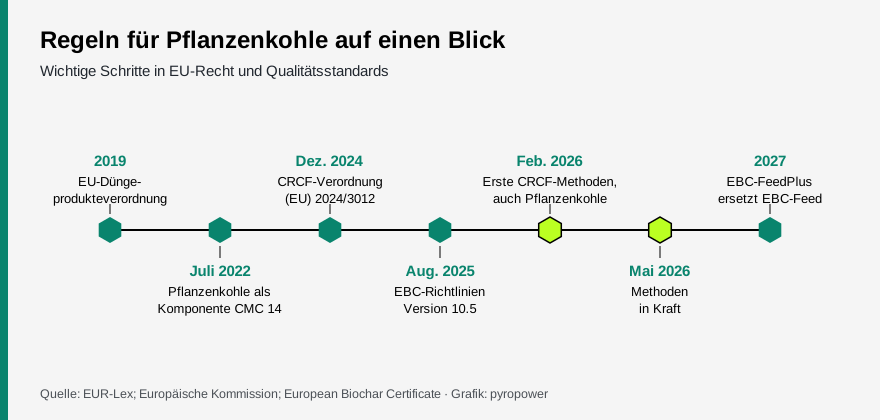
- CRCF: since May 2026 there have been EU methodologies for long-term carbon removals, including biochar.
- For certificates, complete documentation of delivery and use is what counts.

Lucie Töpfer
Managing Director, pyropower GmbH

Three levels that work together
Three levels apply at the same time to biochar on the field. German fertiliser law regulates what may be placed on the market as fertiliser, soil additive or growing medium. European fertilising products law offers a second route with CE marking. And voluntary standards such as the European Biochar Certificate ensure comparable quality, even where the law does not set its own limits. Anyone who also wants to generate carbon certificates needs a recognised certification scheme as a fourth level.
Fertiliser Ordinance
In its list of permitted starting materials, the German Fertiliser Ordinance names charcoal from chemically untreated wood. It may be used as a starting material for growing media and as a carrier material if nutrients are added via approved fertilisers. It is not listed there as a soil additive in its own right. Industry associations such as German Biochar e.V. are campaigning for broader approval based on quality standards. The scientific advisory board on fertiliser issues also considers other starting materials suitable if contaminant limits are met. In practice, this means that wood-based biochar used as a carrier in compost or approved fertilisers is the clearest route. It is best to check the current status together with your supplier.
EU Fertilising Products Regulation
Since July 2022, the EU Fertilising Products Regulation has regulated biochar as component material category 14 for CE-marked fertilising products. Permitted inputs include plant biomass and separately collected biowaste, while sewage sludge, for example, is excluded. Limits apply to the finished material, including an H/C ratio below 0.7 and a maximum of 6 mg/kg for the 16 most important PAHs. Registration under REACH is also required.
EBC classes as proof of quality
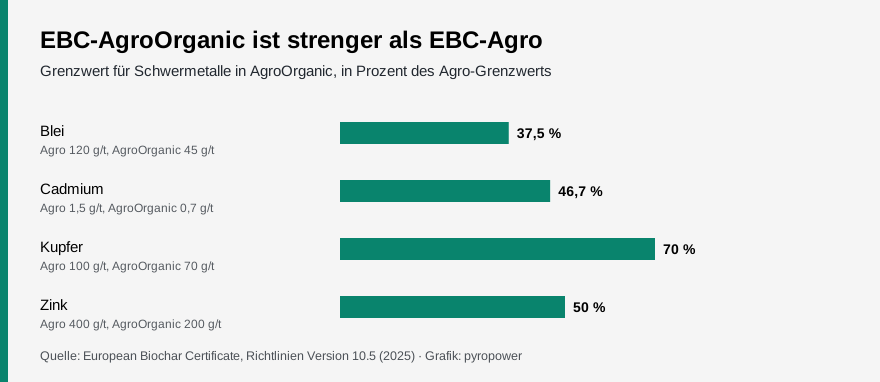
The European Biochar Certificate distinguishes quality classes by application. EBC-Agro and EBC-AgroOrganic are intended for soil, and EBC-FeedPlus for feed from 2027. An H/C ratio below 0.7 applies to all classes. For the soil classes, there are also limits for PAHs and heavy metals, stricter for AgroOrganic than for Agro. Two points from the EBC guidelines are particularly important for farmers: in the first year, only a small part of the nutrients in the biochar is available to plants. And anyone who mixes biochar with compost or digestate and passes it on needs a separate certification for the mixture. The German Environment Agency recommends buying only EBC-certified products and charging fresh biochar with nutrients beforehand.
Certifying carbon storage
With the EU Carbon Removals and Carbon Farming Regulation, CRCF for short, there has been a European framework for certification since 2026. In February 2026, the Commission adopted the first methodologies, including biochar in soil and in materials. They have been in force since May 2026, and certification schemes can now apply for recognition. Voluntary standards such as EBC C-Sink exist in parallel. What they all have in common: the use of the biochar must be traceably documented. Delivery notes, application areas and quantities are therefore more than bureaucracy. They are the basis for every certificate. On request, we take care of certification and marketing for our customers.
Checklist for your purchase
- Check the biochar’s EBC certificate and class: Agro or AgroOrganic for the field, FeedPlus for feed.
- Request a current laboratory analysis with PAHs, heavy metals and H/C ratio.
- Clarify by which legal route the biochar is placed on the market: as a starting material, carrier material or CE product.
- Keep the delivery note with quantity, batch and date.
- Document the field and quantity if you want to use certificates later.
Good to know
The German Environment Agency expressly recommends buying only EBC-certified biochar and charging fresh biochar with nutrients beforehand.
Talk to us
Would you like to use biochar in your business or your product? We advise you on quality, grain size and quantity and provide samples. Feel free to use our contact form or request biochar directly in an XXL big bag .
Frequently asked questions answered briefly
Is biochar from other raw materials also permitted?
In Germany, fertiliser law currently names charcoal from chemically untreated wood. Biochar from other biomass can be placed on the market with CE marking via the EU Fertilising Products Regulation if it meets its requirements.
Are EBC and CE marking both needed?
The EBC is a voluntary quality standard. CE marking under the EU Fertilising Products Regulation is a legal route for placing a fertilising product on the market throughout Europe. The two are not mutually exclusive.
Does every supplier issue certificates for carbon storage?
Certificates for carbon storage are issued by recognised certification schemes. Under the CRCF, such schemes can apply for EU recognition. In addition, there are voluntary standards such as EBC C-Sink.
Sources
German Fertiliser Ordinance, Annex 2 Table 7 (umwelt-online)
Delegated Regulation (EU) 2021/2088, component material category 14
European Biochar Certificate, Guidelines Version 10.5 (2025)
German Environment Agency: Biochar (2026)
European Commission: first methods for long-term carbon removals (February 2026)
top agrar: Biochar in arable farming, current situation (2024)
We summarise the results in our own words. Figures are averages or individual results from the studies mentioned and cannot simply be transferred to every site.
Download
Brochure and data sheet Pyro-ClinX
Technical data, feedstocks, products and the course of a project at a glance (PDF).
Download brochure (PDF)
 info@pyro-power.com
 +49 355 866 870 82
 pyropower GmbH