
Charge first, then apply: how to charge biochar correctly
29.09.2026
Charge first, then apply: how to charge biochar correctly
An empty sponge needs filling
Fresh biochar has a large internal surface but hardly any nutrients. If it goes onto the field untreated, it can initially bind nutrients from the soil. That is why a simple rule applies in practice: charge first, then apply. Here we summarise how this works and what research shows.
Key facts in brief
- Uncharged biochar can initially slow plant growth, while co-composted biochar can clearly promote it.
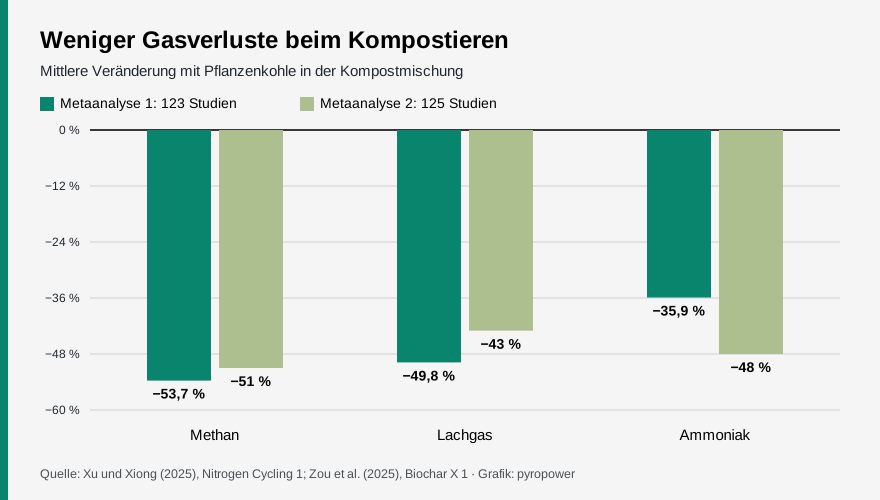
- During composting, biochar reduces methane, nitrous oxide and ammonia by 36 to 54 percent on average.
- 10 to 20 percent biochar in the compost mix has proven effective.
- On fertile sites, field trials often show no measurable effects.
- Under EBC, mixtures with compost or digestate need their own certification.

Lucie Töpfer
Managing Director, pyropower GmbH

What happens during charging
Fresh biochar has a very large internal surface but hardly any bound nutrients. In the soil, it can therefore initially act like a magnet and attract nutrients that are actually meant for the plants. Charging reverses this effect: the biochar absorbs nutrients before it goes onto the field and releases them there slowly. This works best in a biologically active environment such as compost. There, a thin organic layer forms on the biochar that holds nutrients such as nitrate. Researchers speak of a kind of coating that makes the biochar truly valuable for the soil. At the same time, the compost itself benefits: the biochar loosens the mix, improves aeration and binds volatile nitrogen compounds.
The difference in the pot
A frequently cited 2015 trial by Kammann, Schmidt and colleagues shows the difference clearly. On nutrient-poor sand, co-composted biochar produced up to three times the biomass of the control. The same quantity of untreated biochar, on the other hand, reduced biomass to around 60 percent. The co-composted biochar had absorbed large quantities of nitrate that can hardly be measured with standard methods. Follow-up work has shown why: during composting, an organic layer forms on the biochar. It holds nutrients and releases them slowly.
Fewer losses during composting
Two 2025 meta-analyses, each with more than 120 studies, come to similar results. With biochar in the compost mix, the following fell on average:
- methane by 51 to 54 percent
- nitrous oxide by 43 to 50 percent
- ammonia by 36 to 48 percent
At the same time, the germination index, a measure of how well plants tolerate the compost, rose. Shares of 10 to 20 percent biochar, based on dry matter, worked best. With very small shares, the effects were weaker.
On the field, it depends on the site
In the soil, the effects are less consistent. A 2019 meta-analysis found 38 percent less nitrous oxide on average, but with a declining effect after about a year. In 2025, a trial by TU Munich on a very fertile site in southern Germany found no significant effects of biochar and digestate on yield, nitrogen efficiency or nitrate leaching. This does not speak against charging, but for a realistic view: the clearest benefit arises during composting and storage. On the field, biochar pays off above all on light, low-humus soils.
Study in focus
The pot trial that made charging well known
Kammann, Schmidt et al., Scientific Reports, 2015
- Trial on nutrient-poor sand with quinoa.
- Co-composted biochar: up to three times the biomass compared with the control.
- The same quantity of untreated biochar: biomass fell to around 60 percent.
- Explanation: the co-composted biochar had stored large quantities of nitrate that standard analyses hardly detect.
Three proven routes compared
| Route | Advantage | What to watch |
|---|---|---|
| Co-composting | Best charging, lower gas losses in the compost | 10 to 20 percent biochar, manage moisture and aeration as usual |
| Solid manure | Simple via bedding or manure store | Mix in biochar, do not just sprinkle it on top |
| Digestate | Rich in nutrients, available on the farm | Field effects depend on the site, let the mix mature |
How to charge biochar
- Co-composting: Add 10 to 20 percent biochar to the compost mix and manage the compost as usual.
- Manure store: Mix biochar into the solid manure, for example via the bedding.
- Digestate: Mix in biochar and let it mature for some time before application.
- Process it moist: Moistened biochar does not produce dust and absorbs nutrients better.
- Mind the quality: For soil, only use biochar with contaminant analyses according to EBC.
Talk to us
Would you like to use biochar in your business or your product? We advise you on quality, grain size and quantity and provide samples. Feel free to use our contact form or request biochar directly in an XXL big bag .
Frequently asked questions answered briefly
Does charging in compost take long?
The biochar is charged during the normal composting process. Depending on the method, this takes a few weeks to a few months. What matters is that the biochar goes through the hot phase and the maturation phase.
Can the biochar also go directly into the barn?
Via the bedding, too, the biochar gets into the manure and is charged there. This route is well suited for arable land if the biochar is mixed in and not just sprinkled on top.
Can biochar also be charged with mineral fertiliser?
In principle, biochar can also be charged with dissolved nutrients. However, the organic coating that forms during composting does not develop this way. Most experience exists with compost and farm manure.
Sources
Xu, Xiong (2025): Biochar in composting, meta-analysis. Nitrogen Cycling 1
Zou et al. (2025): Biochar in compost, meta-analysis. Biochar X 1
Borchard et al. (2019): Biochar, N₂O and nitrate leaching, meta-analysis. Sci. Total Environ. 651
Sixt, Hülsbergen et al. (2025): Biochar and digestate, TU Munich. Eur. J. Agron. 169
We summarise the results in our own words. Figures are averages or individual results from the studies mentioned and cannot simply be transferred to every site.
Download
Brochure and data sheet Pyro-ClinX
Technical data, feedstocks, products and the course of a project at a glance (PDF).
Download brochure (PDF)
 info@pyro-power.com
 +49 355 866 870 82
 pyropower GmbH