
Sandy soil meets biochar: water that stays
26.10.2026
Sandy soil meets biochar: water that stays
Dry summers, light soils
In Brandenburg and Lusatia, sandy soils shape agriculture. They warm up quickly and are easy to work, but hold little water. In dry springs and summers, this becomes a yield risk. Biochar is therefore often mentioned as a building block for improving the water retention of such soils. We have looked at what research says about this, including all the limitations.
Key facts in brief
- On coarse, sandy soils, field capacity rises considerably on average with biochar, on loam and clay hardly at all.
- A field trial in Brandenburg showed about twice as much plant-available water with compost and biochar.
- Under drought stress, yield and water use efficiency rose in a meta-analysis.
- On fertile soils in temperate latitudes, yield effects are often small.
- The effect builds up over years. Fine grain size and compost strengthen it.

Lucie Töpfer
Managing Director, pyropower GmbH

Why sandy soils lose water
Sandy soils consist of comparatively coarse grains. Between them are large pores through which rainwater drains away quickly. Fine pores that hold water against gravity are rare. In addition, there is often little humus, which itself acts like a sponge. The result: after heavy rain, the soil is quickly dry again, and nutrients move out of the root zone with the seepage water. This is exactly where biochar comes in. It brings its own very fine pore system, which comes from the cell structure of the wood. These pores hold water by capillary forces. At the same time, organic matter and microorganisms attach to the biochar and build up stable soil aggregates over time. On fine loam and clay soils, which already have many small pores, this effect is hardly significant.
What meta-analyses show
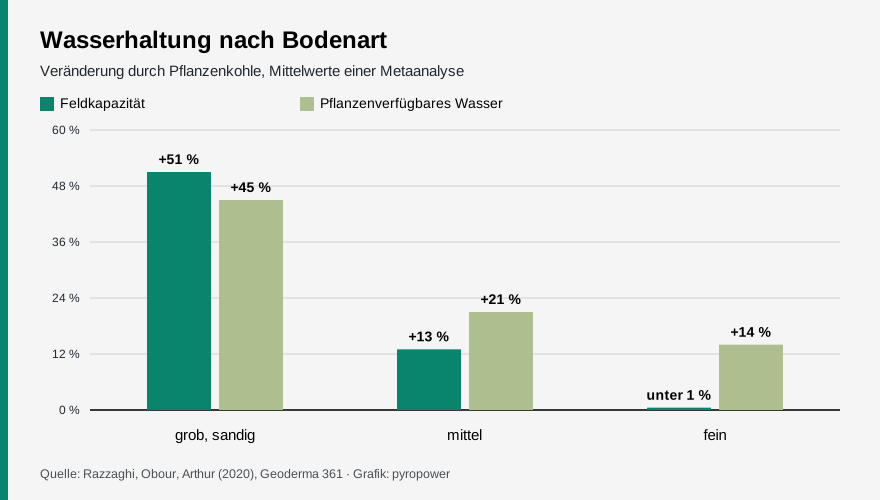
A 2020 meta-analysis by Razzaghi and colleagues evaluated studies on the water retention of soils with biochar. The result depends strongly on the soil type:
- Coarse, sandy soils: field capacity +51 percent on average, plant-available water +45 percent.
- Medium soils: field capacity +13 percent, plant-available water +21 percent.
- Fine soils: practically no change in field capacity.
A more recent evaluation from 2023 arrives at smaller values pointing in the same direction: about +24 percent field capacity on coarse soils. A 2024 review of more than 150 papers confirms the pattern and points to limitations: many results come from short trials or the laboratory, and depending on the feedstock, biochar can even reduce the wettability of the soil.
A field trial on our doorstep
A trial on a sandy site in Brandenburg under maize is particularly revealing. There, compost alone was compared with compost plus biochar. With the combination, organic carbon in the soil rose from 0.8 to 2 percent, plant-available water roughly doubled, and available potassium also rose considerably. Important: the effect came from the interaction of compost and biochar. Trials on sandy soils in northern Germany also showed an effect, but depending on the quantity. At one maize site, the yield only responded at very high applications.
Under drought stress
A 2024 meta-analysis of 25 papers specifically evaluated trials under drought stress. On average, yield rose by 12.5 percent and water use efficiency by 20.6 percent, most strongly on sandy loam. Soya, on the other hand, showed lower yields. For context: a large evaluation of more than 1,000 trials in 2017 found considerable yield increases mainly in the tropics, but hardly any in temperate latitudes. Biochar is therefore not a yield promise for every field, but a tool for sites with little humus and low water retention.
Study in focus
Compost plus biochar on Brandenburg sand
Liu, Schulz, Glaser et al., Journal of Plant Nutrition and Soil Science, 2012
- Site: sandy soil in Brandenburg, maize cultivation.
- Comparison: compost alone versus compost with 5 to 20 tonnes of biochar per hectare.
- Result: organic carbon in the soil from 0.8 to 2 percent, plant-available water roughly doubled, available potassium around 2.5 times higher.
- Lesson for practice: the combination of biochar and organic material makes the difference.
Practical tips
- Choose the site: Light, low-humus sandy soils benefit the most.
- Fine grain size: In trials, fine particles hold considerably more water than coarse pieces.
- With compost: The combination with compost or organic fertiliser worked best in the Brandenburg trial.
- Patience: In practice, smaller quantities are usually applied over several years. The effect builds up.
- Work it in: The biochar belongs in the root zone, not on the surface.
Talk to us
Would you like to use biochar in your business or your product? We advise you on quality, grain size and quantity and provide samples. Feel free to use our contact form or request biochar directly in an XXL big bag .
Frequently asked questions answered briefly
Are small quantities enough to get started?
Many farms start with 0.5 to 2 tonnes of charged biochar per hectare and repeat the application over several years. This builds up the effect step by step, and you can observe the effect on your fields.
Does the effect show in the first year?
In the first year, the effects are often small, especially if only a little biochar has been applied. Water retention grows with the total quantity in the soil and with the time in which biochar, humus and soil life combine.
Is biochar also worthwhile on loam and clay soils?
On heavy soils, the effect on water retention is small because they already have many fine pores. Here, biochar can work more via composting and humus formation.
Sources
Razzaghi, Obour, Arthur (2020): Does biochar improve soil water retention? Geoderma 361
Acharya et al. (2024): Biochar impacts on soil water dynamics. Biochar 6
Liu, Schulz, Glaser et al. (2012): Field trial Brandenburg. J. Plant Nutr. Soil Sci. 175
Zhang, Niu, Luo (2024): Biochar under drought stress. Agronomy 14
Jeffery et al. (2017): Yield effects in the tropics and temperate latitudes, Wageningen University
We summarise the results in our own words. Figures are averages or individual results from the studies mentioned and cannot simply be transferred to every site.
Download
Brochure and data sheet Pyro-ClinX
Technical data, feedstocks, products and the course of a project at a glance (PDF).
Download brochure (PDF)
 info@pyro-power.com
 +49 355 866 870 82
 pyropower GmbH