
The best route for every residue
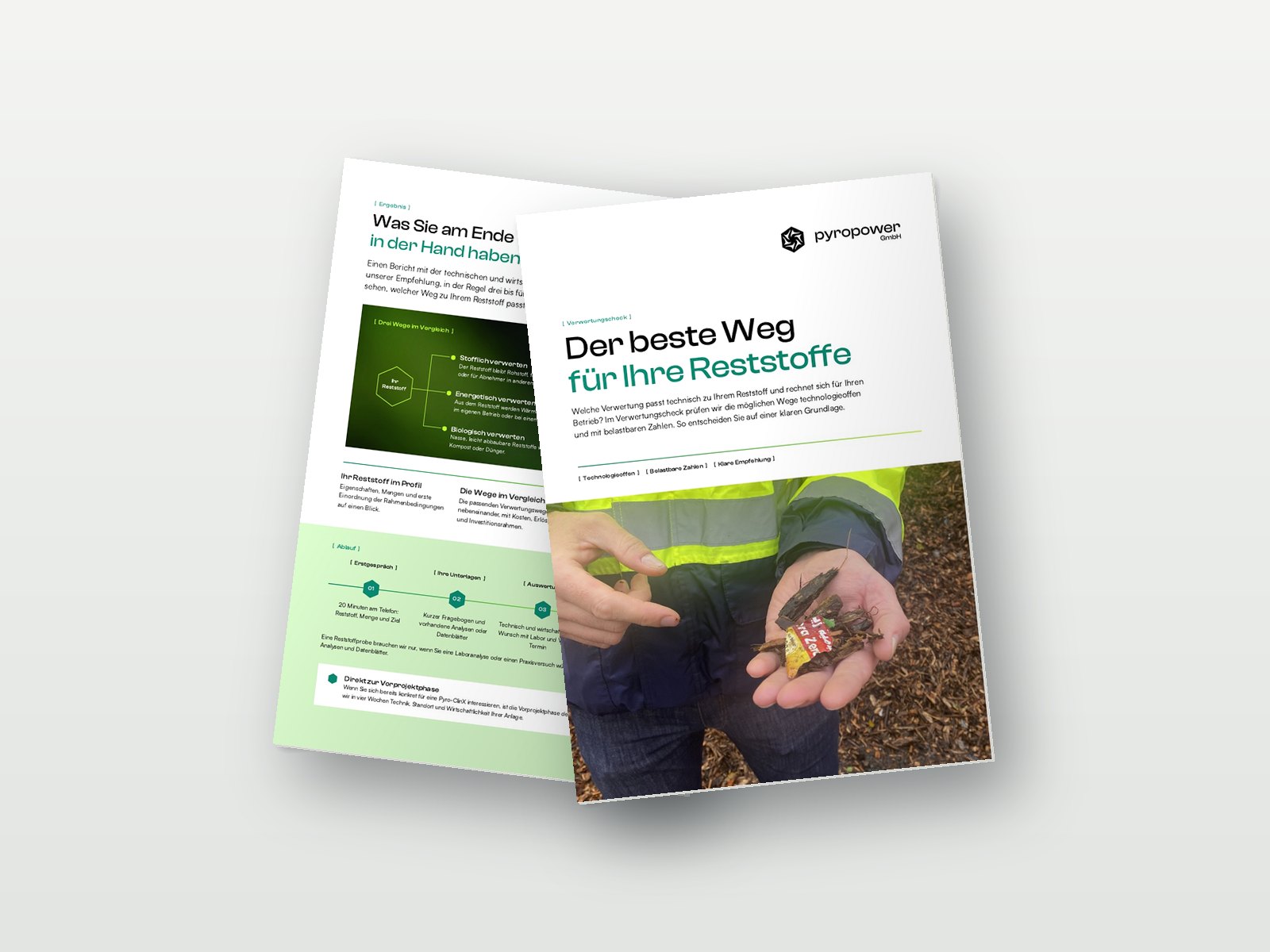
[ Utilization Check ]
Which utilization route fits the residue, technically and economically?
Starting point
One residue, many possible routes. Whether material, energy or biological recovery works best depends on its properties, the volume and the site.
What the Utilization Check covers
Technology-neutral and with reliable figures: we assess every route by the same standards.
01
Volume and occurrence
How much residue accumulates and how it is stored and transported. This determines plant size and logistics.
02
Material properties
Moisture content, calorific value, ash content and particle size, as well as impurities and contaminants. We evaluate existing analyses and data sheets.
03
Regulatory framework
Initial assessment of classification as waste or by-product, waste wood categories and the likely permitting route.
04
Energy demand on site
Your electricity and heat demand. It shows whether using the residue on your own site pays off.
05
Economic viability
Current costs, revenues per route, investment range and payback. All data sources are identified.
06
In more depth on request
Lab analysis, practical test and site visit with photo documentation.
Statements on legal classification are based on experience and do not replace legal advice.
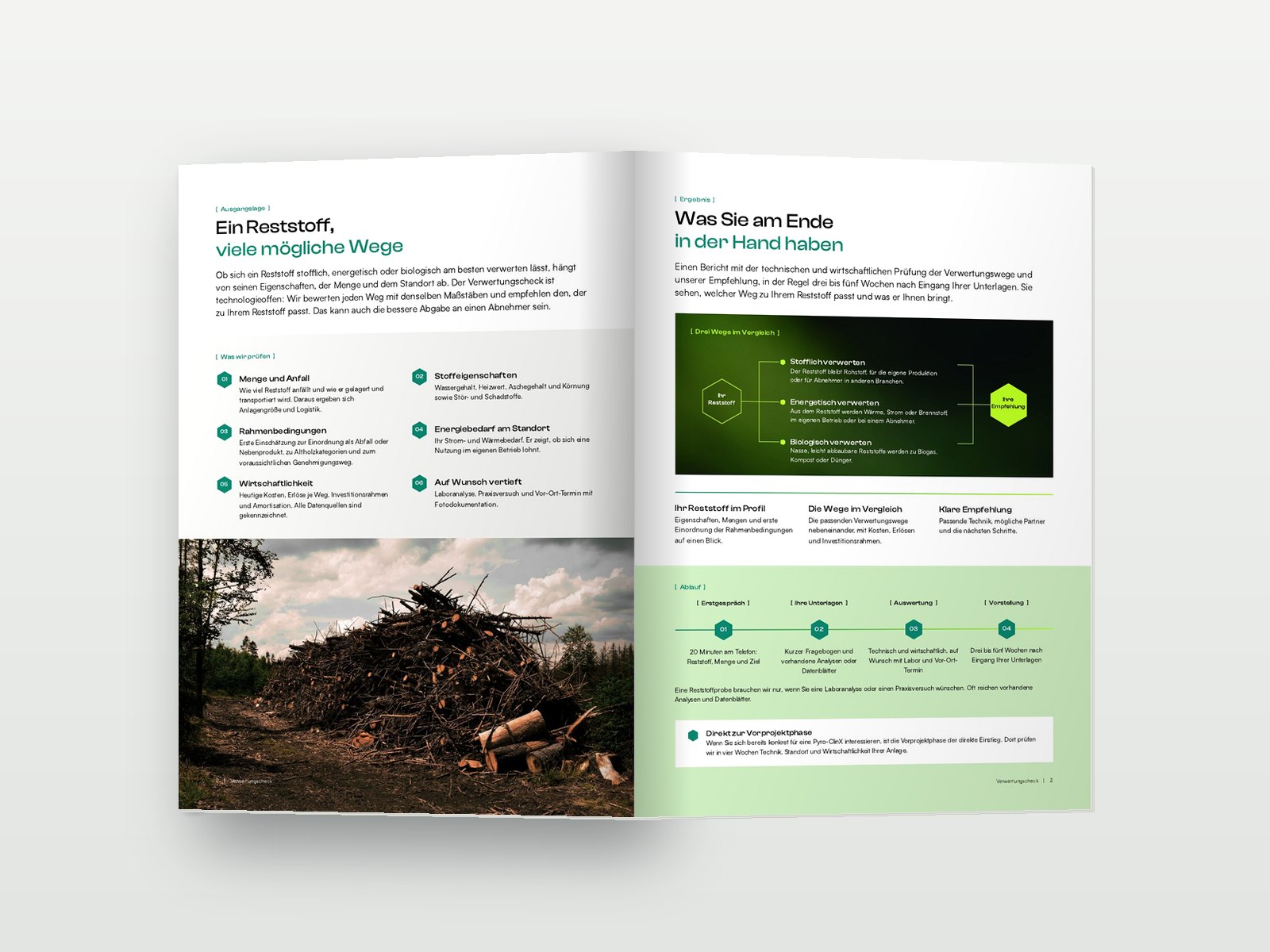
A report with a clear recommendation
You receive a report with the technical and economic assessment of the utilization routes and our recommendation. You see which route suits your residue and what it brings you.
- Residue profile: properties, volumes, regulatory framework
- The routes compared: costs, revenues, investment range
- Clear recommendation: suitable technology, potential partners, next steps
Material, energy or biological
We assess every route by the same standards and recommend the one that suits your residue. That can also mean passing it on to a buyer on better terms.
01
Material recovery
The residue stays a raw material, for your own production or for buyers in other industries.
02
Energy recovery
The residue becomes heat, electricity or fuel, on your own site or at a buyer’s.
03
Biological treatment
Wet, readily degradable residues become biogas, compost or fertilizer.
How the Utilization Check works
From the first call to the presentation of the results.
First call
01
A short call about residue, volume and goal.
Your documents
02
A short questionnaire and existing analyses or data sheets.
Evaluation
03
Technical and economic, with lab analysis and site visit on request.
Presentation
04
We present the report and recommendation to you in person, by video conference or at your site.
We only need a residue sample if you want a lab analysis or a practical test. Existing analyses and data sheets are often sufficient.
Straight to the pre-project phase
If you are already specifically interested in a Pyro-ClinX, the pre-project phase is the direct way in. There we assess the technology, site and economic viability of your plant.
Typical residues by industry

Wood industry and sawmills
Shavings, wood chips, bark, trim ends, sawmill by-products and coated panel offcuts. Coated offcuts are not untreated wood, which narrows the routes.
Paper, packaging and food industry
Label waste, fibre residues, husks, pits and pomace. They often arise wet or with an adhesive layer, and disposal is expensive.
Municipalities, districts and maintenance depots
Green waste, roadside greenery and landscape maintenance material. Volume and quality vary with the season.
Agriculture and forestry
Forest residues, hedge trimmings, straw and harvest residues. They arise seasonally and at many locations.
Digestate and sewage sludge
Using digestate
Biogas plants often have more digestate than their own land can take. Solid digestate after separation can be processed in a pyrolysis plant, producing heat and a carbon-rich residue. Whether this pays off depends on dry matter, ash content and heat use.
It also works the other way round: biochar in the digester can stabilise the fermentation process, and in laboratory studies the methane yield rose significantly. Read more in our article Biochar in the biogas plant.
We test your digestate in the lab and check in a test pyrolysis how well it is suited.
Sewage sludge pyrolysis
From 2029, large wastewater treatment plants in Germany with more than 100,000 population equivalents must recover phosphorus from phosphorus-rich sewage sludge, and from 2032 this also applies to plants with more than 50,000 population equivalents. Spreading the sludge on fields will then end for them.
Pyrolysis is one way to treat sewage sludge in the region: dried sludge becomes a phosphorus-rich carbonisate, and the energy from the pyrolysis gas helps with drying. Whether and how the phosphorus can be used is assessed case by case. Our project Planning a sewage sludge pyrolysis for a water association shows what this can look like.
We test your sewage sludge and calculate the options with you.
Typical residues:




















Frequently asked questions about residue utilization

01 Which residues do you assess?
Mainly biogenic residues: wood, wood residues and industrial wood residues, bark, green waste, landscape maintenance material, straw, husks, pits and pomace. Also composites such as label waste with adhesive layers or coated panel offcuts. For waste wood or digestate, we clarify in advance whether an assessment makes sense.
02 Do you need a sample?
Only if you want a lab analysis or a practical test. Existing analyses and data sheets are often sufficient. We agree on the quantity and packaging of a sample with you.
03 From what volume does your own plant pay off?
That depends on the route: a wood chip boiler pays off at different volumes than a wood chip CHP plant that also generates electricity. For each route, the check states the volume from which it becomes viable.
04 Is my residue waste?
That depends on its origin, treatment and use. Classification as waste or by-product determines the permits and costs of each route. We classify your residue and show the consequences; this does not replace legal advice.
05 Can my residue be turned into biochar?
That depends on the residue, because the EBC standard only permits certain types of biomass. Whether and in what quality can be clarified on request with a lab analysis and a practical test.
06 Are you tied to a particular technology?
We assess every route by the same standards and recommend the one that suits your residue and your site. That can also be a better deal with a buyer.
07 What does the Utilization Check cost?
That depends on the residue and the scope. After a first conversation, you receive a fixed-price offer; lab analysis, practical test and site visit are optional.
08 What will I have in hand after the check?
A report with the technical and economic assessment of the utilization routes and our recommendation, including suitable technology and potential partners. We discuss the results with you personally, by video conference or on site.
09 Do you also support implementation?
You carry out the implementation with the partner, buyer or technology of your choice. In the report, we name suitable technology and potential partners.
Request a quote
Tell us the residue and the volume, that is enough to start. After the first call you receive a fixed-price quote.
Always included: report with recommendation and presentation of the results.
Optional: lab analysis, practical test and site visit.
 info@pyro-power.com
 +49 355 866 870 82
 pyropower GmbH