
Whitepaper biochar in farming and forestry: legal framework and practice in Germany 2026
29.10.2026
Whitepaper biochar in farming and forestry: legal framework and practice in Germany 2026
Biochar may be applied to arable land, grassland and forest soils if the route is right. What matters is less the land itself than the legal form in which the char gets there. This article summarises our whitepaper: which routes are permitted in Germany as of October 2026, what research and practice show, and which questions you should clarify before first use.
You can request the full whitepaper with all sources free of charge.

Lucie Töpfer
Managing Director, pyropower GmbH

Key points
- On arable land and grassland, biochar is permitted as a CE-marked EU fertilising product. Nationally, the German Fertiliser Ordinance only allows charcoal in growing media or as a nutrient carrier.
- In organic farming, biochar from purely plant-based feedstock is on the positive list. It is not permitted in organic feed; in conventional farming it is listed as a feed material.
- Forests have no specific approval. Nursery substrate and planting holes are the clean routes; area-wide application only case by case.
- The benefit depends on the site: above all water retention on sandy soils, nitrogen efficiency and long-term carbon storage. An EU methodology for carbon removal certificates has applied since 7 May 2026.
At a glance: what applies where
Whether biochar may be applied to arable land, grassland or forest soil depends less on the land than on the legal form in which it gets there. The overview shows the situation in Germany as of October 2026.
| Area | Short answer | Status |
|---|---|---|
| Arable land and grassland | Permitted as a CE-marked EU fertilising product. Nationally only charcoal from untreated wood in growing media or as a nutrient carrier. | With conditions |
| Organic farming | Listed as a soil conditioner from purely plant-based feedstock; fertiliser law applies in addition. | With conditions |
| Feed | Permitted as a feed material in conventional farming, not provided for in organic feed. | Conventional only |
| Forest | No specific approval. Nursery and planting holes are the clean routes. | Case by case |
| Agronomic benefit | Above all water retention on sandy soils, nitrogen efficiency and the cascade via barn and compost. | Site-dependent |
| Carbon removal certificates | EU methodology for biochar carbon removal in force since 7 May 2026. | Possible |
The classifications are technical information and do not constitute legal advice.
Arable land and grassland: two permitted routes
Fertiliser law primarily regulates the product. Biochar therefore needs approval as a fertilising product, at EU or national level.
Route A: EU fertilising product with CE marking
Since 16 July 2022, the EU Fertilising Products Regulation (EU) 2019/1009 has regulated biochar uniformly across the EU through component material category CMC 14 “pyrolysis and gasification materials”. A product that meets the requirements and has passed conformity assessment by a notified body may be placed on the market throughout the EU and may also be applied in Germany. The key requirements:
- Feedstock: plants and plant parts, untreated plant residues, residues from bioethanol and biodiesel production, separately collected biowaste; additives up to 25 %
- Excluded: mixed municipal waste, sewage sludge, industrial sludge and dredging sludge
- Process: oxygen-limited, at least 180 °C for at least two seconds
- Stability: molar H/Corg ratio below 0.7
- Contaminants: PAH16 max. 6 mg/kg DM, PCDD/F max. 20 ng WHO-TEQ/kg, ndl-PCB max. 0.8 mg/kg, chloride max. 30 g/kg
- Registration: REACH registration for use as a fertilising product, unless an exemption applies
Route B: German Fertiliser Ordinance
The German Fertiliser Ordinance (DüMV) does not recognise the term biochar. Only charcoal with at least 80 % carbon from chemically untreated wood is permitted, and only as a component of growing media and as a carrier for nutrients. It is not approved as a soil additive or fertiliser. An opening of the DüMV has not been decided; the German Scientific Advisory Board on Fertiliser Issues considers it justifiable with external quality assurance.
Legislative status
The Second Act amending the German Fertiliser Act is intended, among other things, to regulate the national implementation of the EU Fertilising Products Regulation. After the cabinet decision in April and the first reading in June 2026, the hearing in the Bundestag agriculture committee took place on 8 September 2026. This does not change the status of CE-marked products.
Interim conclusion for arable land
- Permitted: CE-marked EU fertilising product under CMC 14, the most practical route
- Permitted but narrow: DüMV charcoal in growing media or as a nutrient carrier
- Not permitted: uncertified char not declared as a fertilising product, applied directly to fields
Organic farming, livestock and manure
In organic farming, biochar has been on the positive list of fertilisers and soil conditioners since 2020, today Annex II of Implementing Regulation (EU) 2021/1165. It must be a pyrolysis product made from purely plant-based material. Fertiliser law applies in addition, so in practice this means a CE product made from plant-based char.
In conventional livestock farming, biochar is listed as a feed material (EU Catalogue No. 7.13.1), with strict limits for dioxins and heavy metals. It is not permitted in organic feed. Its use in bedding and compost is common practice; the rules for manure and compost apply. It is not listed as a slurry additive, so please clarify this with the fertiliser authority in advance.
Results from research and practice
Biochar is neither a fertiliser nor a yield promise. Its value lies in soil function, nutrient management and long-term carbon storage. Light sandy soils low in humus benefit in particular.
- −32 % nitrous oxide: average reduction in nitrous oxide emissions across the studies evaluated
- −22 % nitrate: average reduction in nitrate leaching
- double the water holding capacity: field trial on sandy soil in Brandenburg with compost and char
Source: German Scientific Advisory Board on Fertiliser Issues 2023 (meta-studies, Brandenburg field trial). On well-supplied soils in Central Europe, general yield increases have not been demonstrated. In the tropics, biochar works mainly by liming and fertilising acidic, poor soils; in Germany its value lies in water retention, nitrogen efficiency and long-term carbon storage.
Charging and cascading
Fresh char contains hardly any available nutrients. It works best when it is charged beforehand and first serves a purpose on the farm. A proven approach is the cascade: in feed the char binds in the gut, in bedding it reduces moisture and odour, in compost it takes up nutrients, and in the soil it acts as a reservoir and carbon sink.
- Compost: about 10 to 30 % char, always processed moist
- Bedding: about 5 to 10 %
- Application: 0.5 to 2 t per hectare and year, in the row or root zone rather than across the whole field, using a compost or manure spreader, shallowly incorporated
Site and quality
Biochar has the clearest effect on sandy soils low in humus with drought stress; on fertile loess the effect is small. Quality matters just as much: char from slow to intermediate pyrolysis above 450 °C is stable, and clean separation of char and gas lowers PAH. For soil, EBC-Agro or EBC-AgroBio are recommended, wood-based char of medium grain size rather than fine dust, and analysis using toluene extraction. Feedstock determines quality, EBC class and legal status; woody and fibrous residues with low contaminant content are well suited.
Three typical routes into practice
Which application makes sense depends on the farm, the soil and the goal. These three situations are particularly common in practice.
1. Arable farming on light soils
Sandy soils low in humus with drought stress, as in Brandenburg and Lusatia.
- Goal: keep water and nutrients in the root zone, build humus, store carbon.
- How: charge via compost or manure, 0.5 to 2 t per hectare and year, incorporate shallowly or apply in the row.
- Legal: CE-marked EU fertilising product or part of a compliant compost.
2. Livestock with a cascade
Cattle, pigs or poultry: the char passes through the barn first, then the field.
- Goal: improve barn climate and odour, bind nitrogen in manure, bring charged char to the field.
- How: feed-grade char according to EBC-Feed, 5 to 10 % in bedding, compost and spread the manure.
- Legal: permitted as a feed material in conventional farming, not as feed on organic farms; clarify slurry use in advance.
3. Forest and reforestation
Calamity areas, dry sandy sites, afforestation with broadleaved trees.
- Goal: secure the establishment of young trees, promote roots, retain water in the planting hole.
- How: into the nursery growing medium or in small, charged amounts into the planting hole.
- Legal: nursery substrate is the clean route; agree planting-hole use with the authority and certifier in advance.
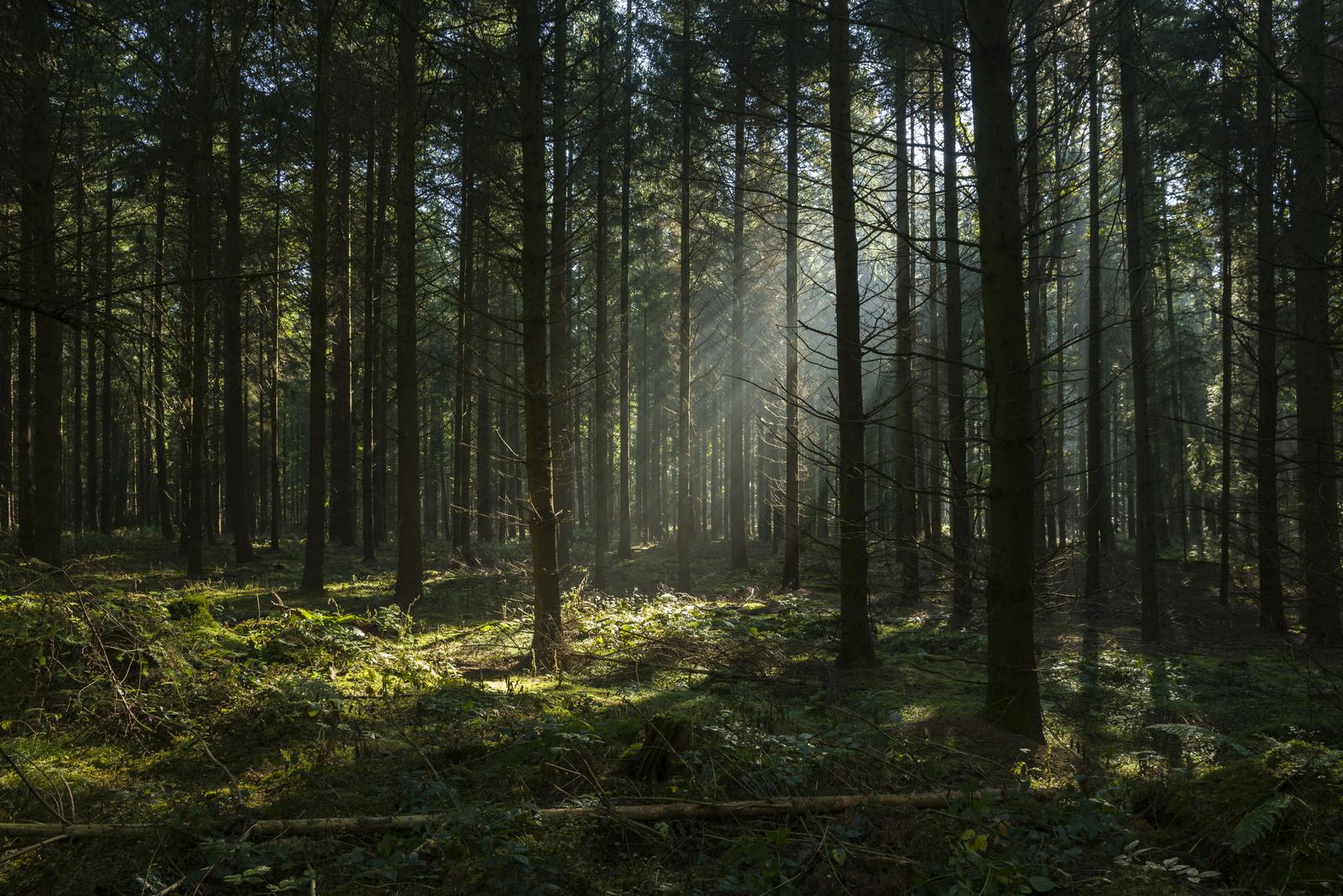
Forests and reforestation: clean routes without a specific approval
There is no specific rule for biochar on forest soils. Fertiliser law, soil protection law, forest law and certification apply.
- Fertiliser law: the product rules also apply in forests; a CE- or DüMV-compliant product is required.
- Soil protection: if a material does not meet fertiliser law, sections 6 to 8 of the Federal Soil Protection Ordinance (BBodSchV) apply to its incorporation.
- Forest law and certification: state forest acts require proper forest management; FSC excludes fertilisation to increase yield and allows liming only for soil protection. Protected areas may prohibit fertilisation.
| Application | Note | Status |
|---|---|---|
| Nursery, container | DüMV growing medium with charcoal or CE product | Permitted |
| Planting holes in afforestation | Compliant product; check FSC, PEFC and funding conditions | With conditions |
| Urban and street trees | Established tree substrates, such as the Stockholm model | Permitted |
| Area-wide on forest soil | Only after consulting forestry and soil protection authorities | Case by case |
Results in reforestation
A meta-study (Thomas and Gale 2015) found on average 41 % more biomass in young trees after char application. Broadleaved species respond more strongly than conifers, young plants particularly clearly. In trials with older trees, it was usually not height but stem diameter that increased, an indication of stronger roots. Field trials, such as those by the Hessian agency HLNUG in Lampertheim, also show that application matters more than quantity.
- Via the nursery: char in the growing medium, legally clean and precisely dosed
- Targeted: small, charged amounts with compost in the planting hole; not area-wide, no rotary tilling
- Always charged: with compost or an organic nutrient solution, no mineral nitrogen
- Target sites: dry sandy and calamity areas, mixed broadleaved stands
- Make it measurable: control plots, spring planting, monitoring over several years
Carbon removal certificates under the EU methodology
Delegated Regulation (EU) 2026/285 has applied since 7 May 2026 as the first EU methodology for permanent carbon removals, including biochar carbon removal. It covers storage through application to soils and incorporation into materials. The first units are expected at the end of 2026 or in 2027.
- The H/Corg ratio is measured for each batch; above 0.7, no units are issued.
- Permanence is demonstrated by reflectance measurement or a decay model over 200 years.
- If char accounts for more than half of a plant’s energy products, only residues and waste are permitted as feedstock.
Whether and to what extent certificates are generated depends on the certification programme, the documentation and third-party verification. For farms, this means documenting delivery, analysis and application carefully.
Seven questions before first use
- Has the char been placed on the market as a CE product or a DüMV-compliant component?
- Are analyses of H/Corg, PAH, dioxins and heavy metals available?
- Will the char be charged beforehand, via barn, compost or nutrient solution?
- Does the site fit: sandy, low in humus, dry?
- Is the quantity practical and targeted at the root zone?
- Organic farm or forest: are the inspection body, authority and certifier involved?
- Are carbon removal certificates intended, and is the documentation in place?
Request the whitepaper free of charge
The whitepaper “Biochar in farming and forestry in Germany” summarises the legal framework, research results and the checklist on 12 pages, with all sources. After submitting, you will receive the download link.
The whitepaper is for technical information only and does not constitute legal advice.
Support from pyropower
Tell us your site, area and goal; that is enough to start. We discuss with you which route fits your farm agronomically and which bodies you should involve for the legal review.
- Buy biochar: from our own production from December 2026, according to the EBC standard. We discuss with you which use fits agronomically: barn, compost or field. Biochar from pyropower
- Plan a field trial: arable land, barn or reforestation. We discuss material, quantity and procedure.
- Pyro-ClinX for your site: residues are turned into electricity, heat, biochar and carbon removal certificates. We take the biochar and certificates off your hands. Pyro-ClinX 150
- Use your own residues: wood residues from your operation can be used; we check which use fits.
Frequently asked questions
May I apply biochar to my fields in Germany?
Yes, as a CE-marked EU fertilising product under component material category CMC 14, or as part of a compliant compost. Uncertified char applied directly to fields is not permitted.
Is biochar allowed on organic farms?
As a soil conditioner from purely plant-based feedstock, yes; fertiliser law applies in addition. As feed it is not permitted on organic farms. Involve your inspection body in advance.
How much biochar is applied per hectare?
In practice 0.5 to 2 t per hectare and year, charged via compost or manure and placed in the row or root zone.
Can I use biochar in forests?
There is no specific approval. Use via nursery growing media is clearly regulated; use in planting holes is possible subject to conditions. Area-wide application on forest soil only after consulting the authorities.
Does biochar increase yields?
On well-supplied soils in Central Europe, general yield increases have not been demonstrated. The benefit lies mainly in water retention on sandy soils, nitrogen efficiency and long-term carbon storage.
When will pyropower supply biochar?
From December 2026 from our own production, according to the EBC standard. We discuss with you which use fits agronomically: barn, compost or field.
Which EBC class do I need for fields and barns?
For soil EBC-Agro, in organic farming EBC-AgroBio, for feed and bedding EBC-Feed.
May biochar be added to slurry?
Biochar is not listed as a slurry treatment additive. Please clarify its use with the competent fertiliser authority in advance.
Are there carbon removal certificates for biochar in soil?
Yes, an EU methodology has applied since 7 May 2026. The first units are expected at the end of 2026 or in 2027; whether certificates are generated depends on the programme, documentation and verification.
Sources
- Regulation (EU) 2019/1009; Delegated Regulation (EU) 2021/2088 (CMC 14)
- Implementing Regulation (EU) 2021/1165, Annexes II and III
- German Federal Ministry of Agriculture (BMLEH): fertilisation, Fertiliser Act and Fertiliser Ordinance (2026)
- German Bundestag: printed paper 21/6135; agriculture committee hearing 08.09.2026
- German Scientific Advisory Board on Fertiliser Issues: biochar in crop production (2023)
- Bavarian State Research Center for Agriculture (LfL): biochar in arable farming; biochar in piglet feeding
- European Biochar Certificate: guidelines and positive list (2025)
- Jeffery et al. (2017), Environmental Research Letters 12
- Thomas and Gale (2015), New Forests
- HLNUG: biochar in forestry, Lampertheim field trial
- LABO: enforcement guidance on sections 6 to 8 BBodSchV (2023)
- European Commission: CRCF, Delegated Regulation (EU) 2026/285
The full list of sources is in the whitepaper.
Legal notes
- No legal advice: This article and the whitepaper are for technical information only. They do not constitute legal advice, a legal recommendation or binding information and do not replace review by a lawyer or the competent authority.
- Status and changes: The content reflects the state of law and research in October 2026. Fertiliser law, organic farming rules and carbon removal certification continue to evolve; in particular, the amendment of the German Fertiliser Act and a possible change to the Fertiliser Ordinance (DüMV) may change the legal situation.
- Federal states and individual cases: Forest acts, nature conservation requirements and the enforcement of fertiliser law differ between the German federal states. The competent bodies decide case by case whether a specific application is permitted, for example the fertiliser authority, the chamber of agriculture, the forestry and soil protection authorities, the organic inspection body and the certifier.
- Effects: The research results cited are averages and highly site-dependent. They are not a guarantee of specific yields, emission reductions or soil effects.
- Carbon removal certificates: Whether and to what extent certificates are generated depends on the certification programme, the documentation and third-party verification.
- Liability: The content has been carefully researched. pyropower GmbH accepts no liability for completeness, accuracy or timeliness; liability for decisions based on this article or the whitepaper is excluded to the extent permitted by law.
 info@pyro-power.com
 +49 355 866 870 82
 pyropower GmbH