
What Is Pyrolysis? Explained Simply: From Wood Residues to Power, Heat and Biochar
04.09.2026
What Is Pyrolysis? Explained Simply: From Wood Residues to Power, Heat and Biochar
In short: Pyrolysis is the decomposition of biomass by heat in the absence of oxygen. Wood is converted into pyrolysis gas, condensable vapours and biochar. Slow pyrolysis yields a lot of char, fast pyrolysis mainly liquid oil.
Pyrolysis sounds like high tech, but the principle is old: wood is heated without air getting to it. It does not burn, it breaks down into gas, vapours and char. Charcoal burners made charcoal this way for centuries. Today the process runs continuously, under control and with full use of the energy.
In this article I explain what happens inside the wood during pyrolysis, how temperature and residence time determine the result and how pyrolysis differs from gasification and combustion.

Sebastian Kießling
Managing Director Technology, pyropower GmbH

Key points at a glance
- Pyrolysis is the thermal decomposition of biomass in the absence of oxygen.
- It produces three products: pyrolysis gas, condensable vapours and biochar.
- Slow pyrolysis at medium to high temperatures yields a lot of char. Fast pyrolysis mainly yields liquid pyrolysis oil.
- The higher the temperature, the richer in carbon and the more stable the char becomes.
- In the Pyro-ClinX, the pyrolysis gas is used directly to generate power and heat. The char is the fourth product alongside power, heat and CO₂ certificates.
What happens inside the wood during pyrolysis?
Wood consists mainly of three building blocks: cellulose, hemicellulose and lignin. They decompose at different temperatures. Yang and colleagues (2007) measured this in detail.
Drying up to about 150 °C
First the water evaporates. The wetter the wood, the more energy goes into this step. That is why good drying of the wood chips matters.
Hemicellulose and cellulose from about 220 °C
Hemicellulose breaks down roughly between 220 and 315 °C, cellulose mainly between 315 and 400 °C. This releases most of the gases and vapours.
Lignin over a wide range
Lignin decomposes slowly over a very wide temperature range up to well above 700 °C. A large share of the solid char comes from it.
Carbonisation at high temperatures
As the temperature rises further, the remaining carbon arranges itself into stable aromatic structures. Hydrogen and oxygen continue to be released and the carbon content increases.
What determines the result of pyrolysis?
How much gas, oil and char is produced depends mainly on temperature, heating rate and residence time. Bridgwater (2012) compiled typical yields:
- Fast pyrolysis: very rapid heating to around 500 °C, vapours stay in the reactor for only seconds. Result: up to 75 percent liquid pyrolysis oil, little char.
- Slow pyrolysis: slow heating, long residence time. Result: roughly one third each of char, liquid and gas.
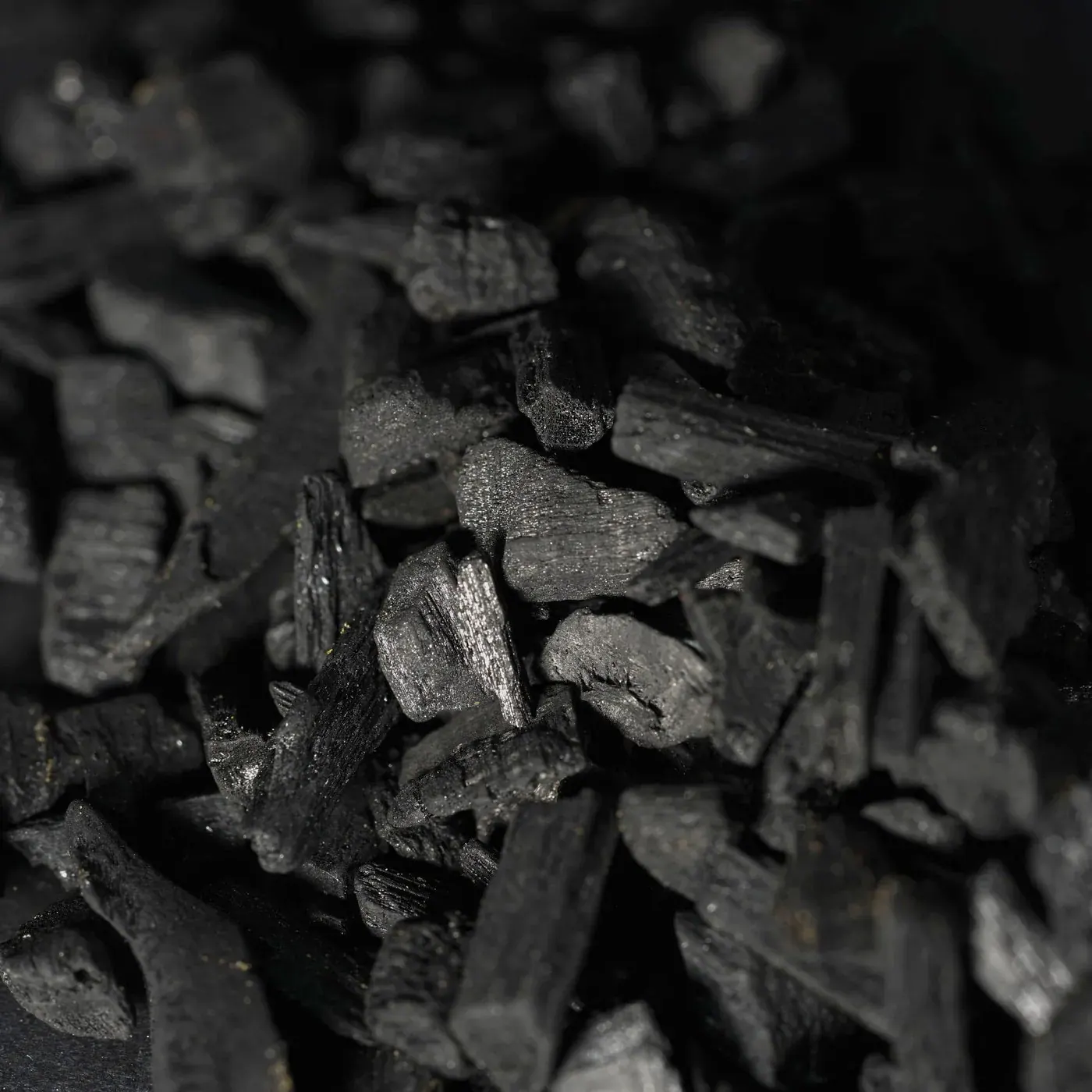
For biochar, slow pyrolysis is the method of choice. As the temperature rises the char yield falls, but the char becomes richer in carbon, more porous and more stable. In the Pyro-ClinX we work at 650 to 800 °C. This produces a stable, porous char that can meet the requirements of the European Biochar Certificate (EBC).
Which residues are suitable?
Woody residues in the form of wood chips are suitable for pyrolysis in the Pyro-ClinX:
- Forest residues and landscape maintenance wood
- Sawmill by-products and untreated industrial waste wood
- Bark as well as tree and shrub cuttings
A uniform particle size and good drying are important. For biochar intended for soils or animal feed, the EBC also specifies which feedstocks are permitted. Painted or treated wood does not belong in the plant.
How much biochar is produced?
The Pyro-ClinX processes around 315 kg of wood chips per hour. This produces around 75 kg of biochar, roughly a quarter of the input mass. The rest becomes pyrolysis gas and supplies power and heat in the process. The exact yield depends on the wood, its moisture content and the reactor temperature.
How does pyrolysis differ from gasification and combustion?
The three processes differ in how much oxygen is involved.
- Combustion: with enough air the wood is fully oxidised. What remains is heat, flue gas and ash. No carbon is stored.
- Gasification: with little air, as much biomass as possible is converted into combustible gas. The char is a residue that should stay as small as possible.
- Pyrolysis: without air, gas and char are produced side by side. The char is an intended product.
Pyrolysis in the Pyro-ClinX
In the Pyro-ClinX, pyrolysis runs continuously in a heated reactor. The pyrolysis gas flows directly into the FLOX combustion chamber, where it is oxidised flamelessly. Via a high-temperature heat exchanger, the heat drives the externally fired micro gas turbine, and the remaining heat is available as useful heat. The char is discharged, cooled and bagged. This turns one residue into four products: power, heat, biochar and CO₂ certificates.
Frequently asked questions
At what temperature does pyrolysis take place?
Pyrolysis starts at a few hundred degrees. For biochar, temperatures usually range from about 400 to 800 °C. In the Pyro-ClinX reactor it is 650 to 800 °C.
Is pyrolysis a form of combustion?
No. In pyrolysis there is no oxygen, so the material does not burn. Only the resulting gas is oxidised in a second step, in the Pyro-ClinX system flamelessly in the FLOX combustion chamber.
Which materials can be pyrolysed?
In principle any organic material. For biochar used in soils, only untreated plant biomass is eligible according to the requirements of the European Biochar Certificate (EBC), for example wood chips, bark or landscape maintenance wood.
How much biochar is produced?
That depends on the feedstock and the process. In the Pyro-ClinX, around 20 to 25 % of the input remains as biochar.
What is the difference from charcoal made in a kiln?
In a traditional kiln, part of the wood is burned to char the rest. Gas and heat are lost. In a modern plant, pyrolysis runs continuously and under control, and the gas is used completely.
Can green cuttings or digestate be pyrolysed?
In principle yes, depending on moisture and composition. We check case by case whether a residue is suitable and what quality the char will then reach.
Does pyrolysis produce smoke?
No. The reactor is closed. The pyrolysis gas is fully oxidised in the combustion chamber, the exhaust gas gives off its heat and leaves the plant via the stack.
Sources
- Bridgwater, A. V. (2012): Review of fast pyrolysis of biomass and product upgrading. Biomass and Bioenergy 38, 68 to 94.
- Yang, H. et al. (2007): Characteristics of hemicellulose, cellulose and lignin pyrolysis. Fuel 86, 1781 to 1788.
- Lehmann, J., Joseph, S. (eds.) (2015): Biochar for Environmental Management: Science, Technology and Implementation. 2nd edition, Routledge.
- Lehmann, J. et al. (2021): Biochar in climate change mitigation. Nature Geoscience 14, 883 to 892.
- European Biochar Certificate (EBC): Guidelines for the certification of biochar.
Download
Pyro-ClinX product brochure
Technical data, feedstocks, products and the course of a project at a glance (PDF).
Download brochure (PDF, German)
 info@pyro-power.com
 +49 355 866 870 82
 pyropower GmbH